I led research as part of a two-person design team, along with deep partnership from the Medtronic Customer Experience Team. Over a six-week period, we conducted on-site qualitative interviews with healthcare professionals, synthesized insights, and co-designed their future MRI experience and workflows to reduce Medtronic service burden and increase adoption.
Case study · 04 of 05
A new digital + physical MRI experience for Medtronic device patients.
Patients with Medtronic-implanted devices faced friction at every MRI appointment, and the burden of explaining safety, settings, and procedure fell on Medtronic's field clinical team.
Over six weeks, our two-person team, in deep partnership with Medtronic's Customer Experience group, set out to redefine the MRI experience end-to-end, reduce service burden, and unlock broader adoption.
Approach
A small team, a focused window, and a full system to understand.
Engagement
9
Facilities visited across two U.S. geographies
32
Healthcare professionals interviewed in-situ
6 wks
End-to-end engagement, research through delivery
Outcome
Our team delivered strategic insight into how MRIs for device patients are handled today, pain points, opportunities, best practices, and change management recommendations.
We also delivered two future solutions: workflow changes that could be rolled out immediately, and concepts that included a physical device. These findings were integrated into future Medtronic MRI protocols and rolled out nationwide.
01 / Research
Sitting with the people who actually run the scan.
Method
Through qualitative user research, we sought to gain an in-depth understanding of the MRI process for conditional devices from the perspective of radiologists and MR techs, cardiologists / EPs and their nurses, and Medtronic clinical specialists.
We took an ethnographic approach, interviewing each role individually in their hospital setting. Sessions were 1–2 hours in duration, and included an interview and activities such as card sorting, journey mapping, and co-creating desired solutions to challenges identified in the MR workflow, from the perspective of each role.
Figure 01
On-site ethnographic sessions, journey mapping & card sorting in situ.
1 / 3
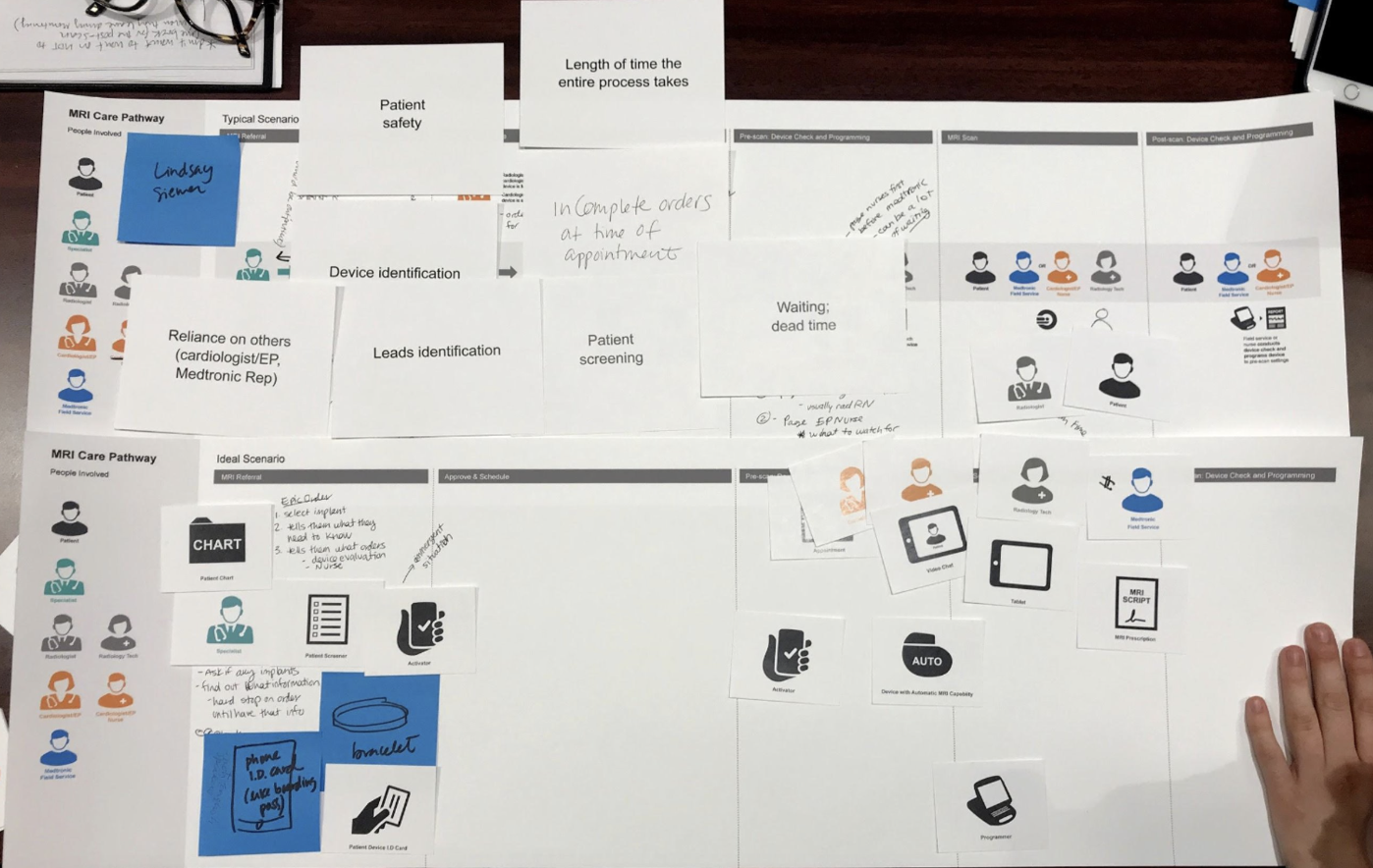
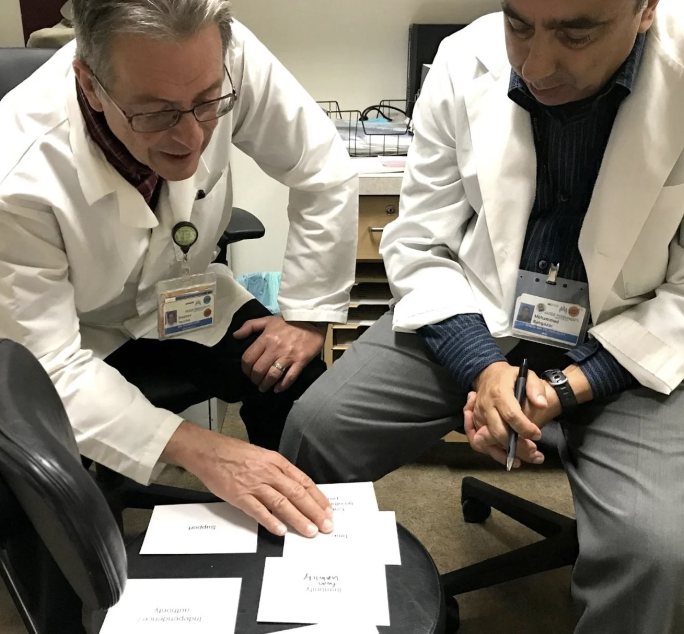
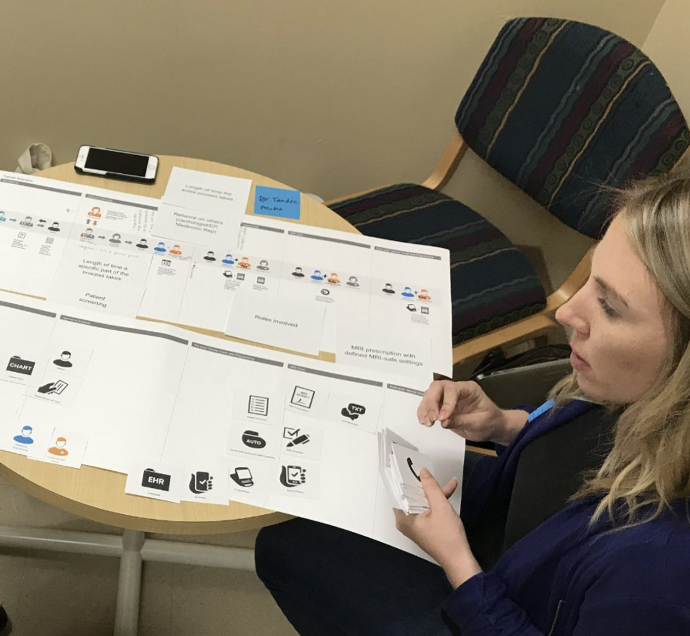
MRI Care Pathway worksheet, typical vs. ideal scenario, annotated with pain points.
What we asked
- Walk us through an MRI for a device patient, end to end, who is involved, when, and why.
- Where does the workflow break down today, and who absorbs that work?
- What does each role need to feel confident handling a conditional device themselves?
- If you could redesign the experience tomorrow, what would change first?
Research deliverables
- Current-state journey map with pain points & opportunities
- Card-sort ranking of psychological needs by role
- Cross-role insight set on adoption and service burden
- Best-practice patterns observed across facilities
02 / Design & Delivery
From insight to a workable plan, short term, long term, and physical.
Approach
After our research and co-design sessions, we translated the findings into insights and strategic recommendations to improve workflow and support adoption of MRI responsibilities for device patients.
These findings were presented to cross-functional stakeholders across Medtronic and were used to drive short- and long-term decisions related to MRI support. Here is a bit of what we learned & delivered.
Workflow recommendations
Immediate changes to roles, hand-offs, and pre-scan steps, designed to be adopted by facility staff without new tooling.
Personas
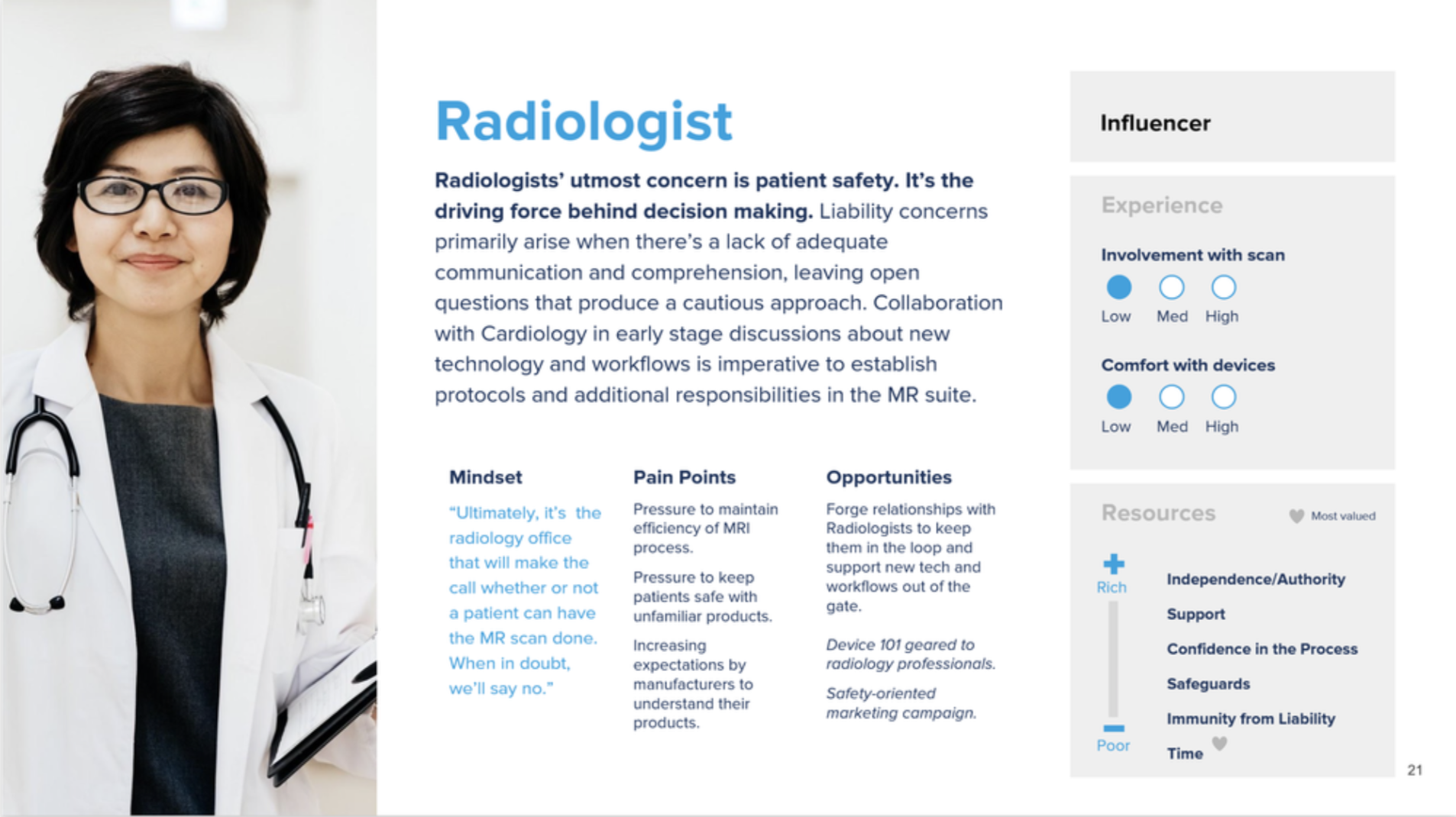
Five role-based personas covering the MRI workflow, radiologist, MR tech, cardiologist / EP, nurse, and Medtronic clinical specialist.
Change management recommendations
Guidance for Medtronic's Customer Experience team on how to introduce new responsibilities and protocols without breaking trust with facilities.
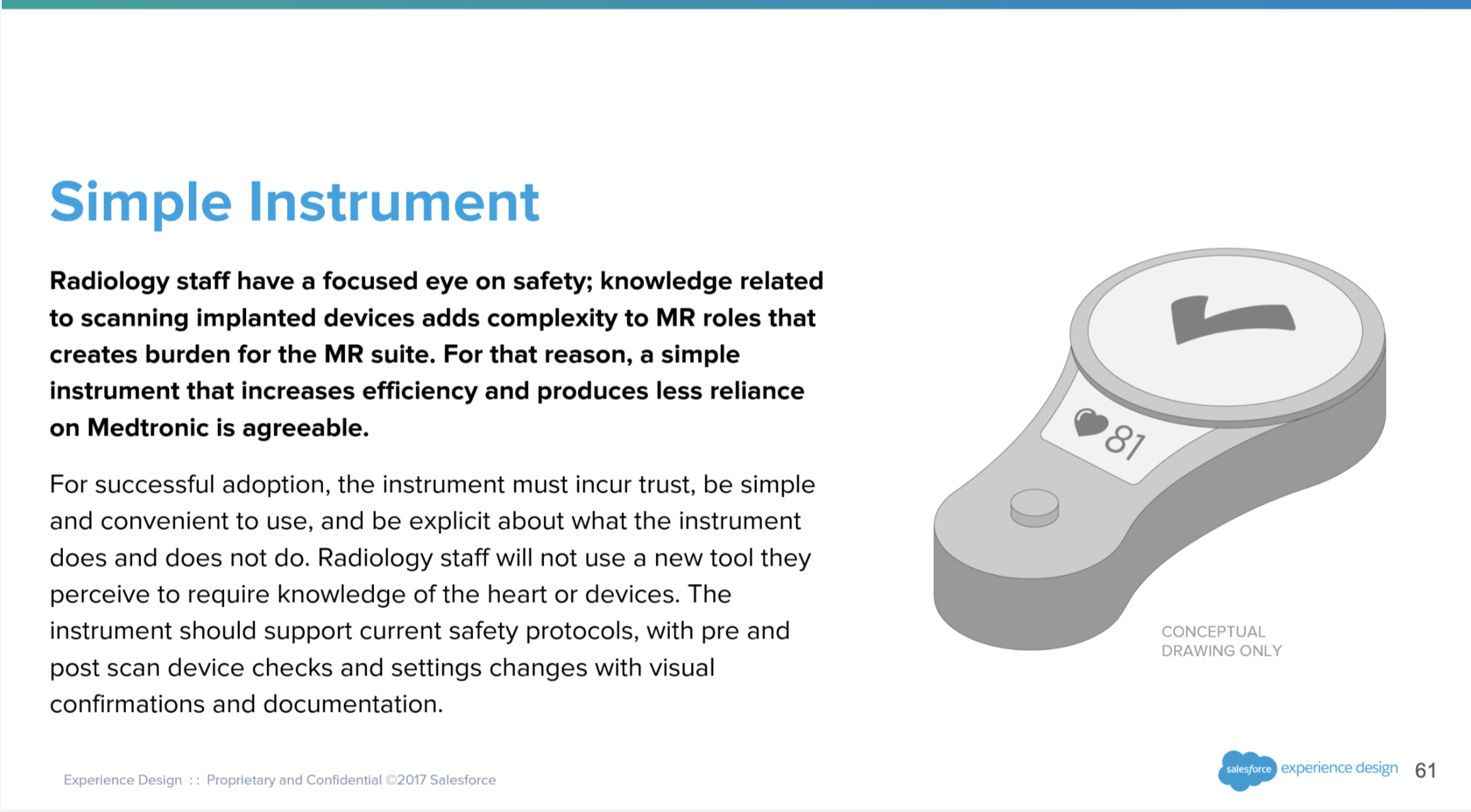
Physical device concept
A future-state concept pairing workflow change with a purpose-built device, reducing the moments where a Medtronic specialist has to be physically present.
Figure 02
A Model Workflow for Today, end-to-end, role by role.
1 / 3
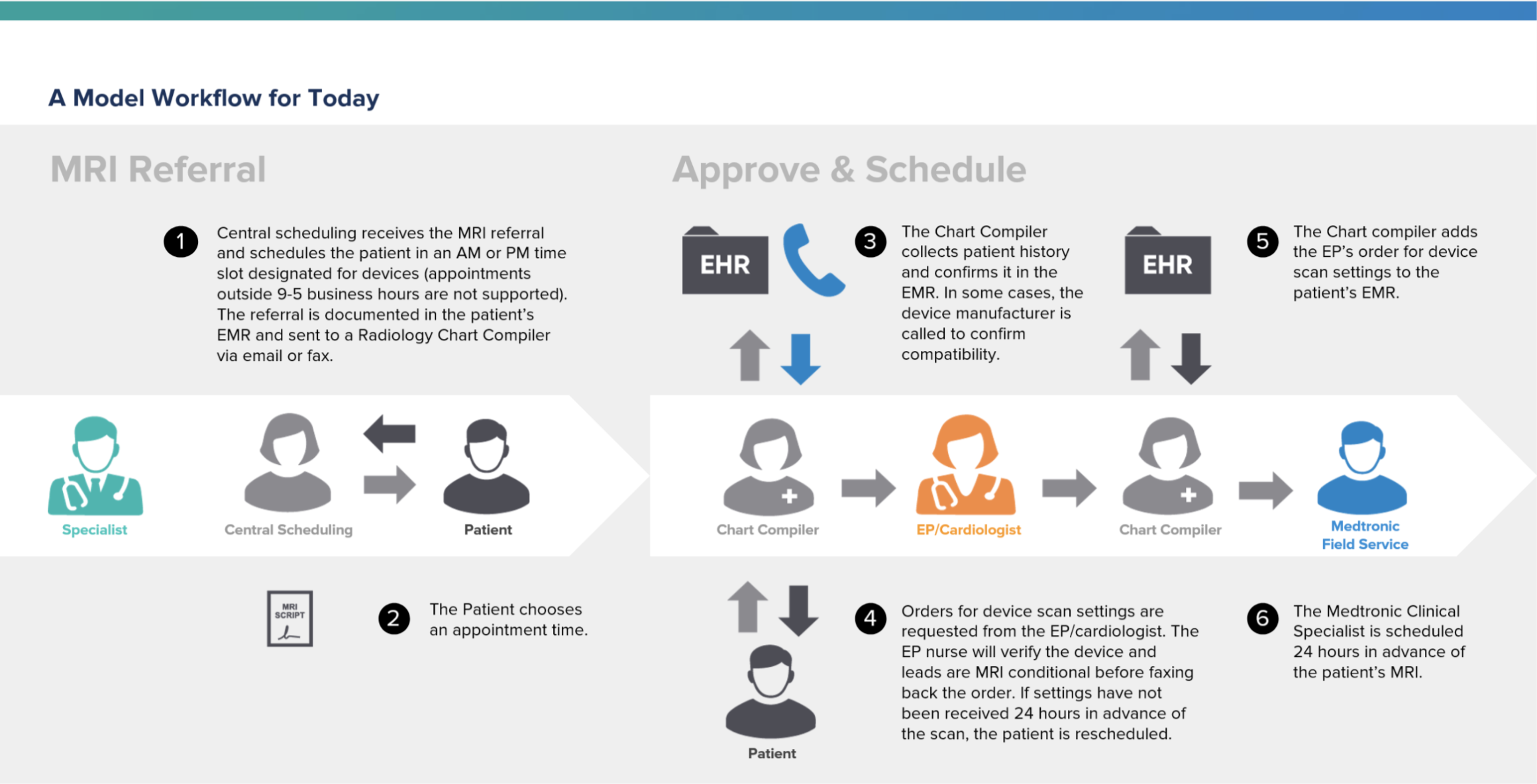
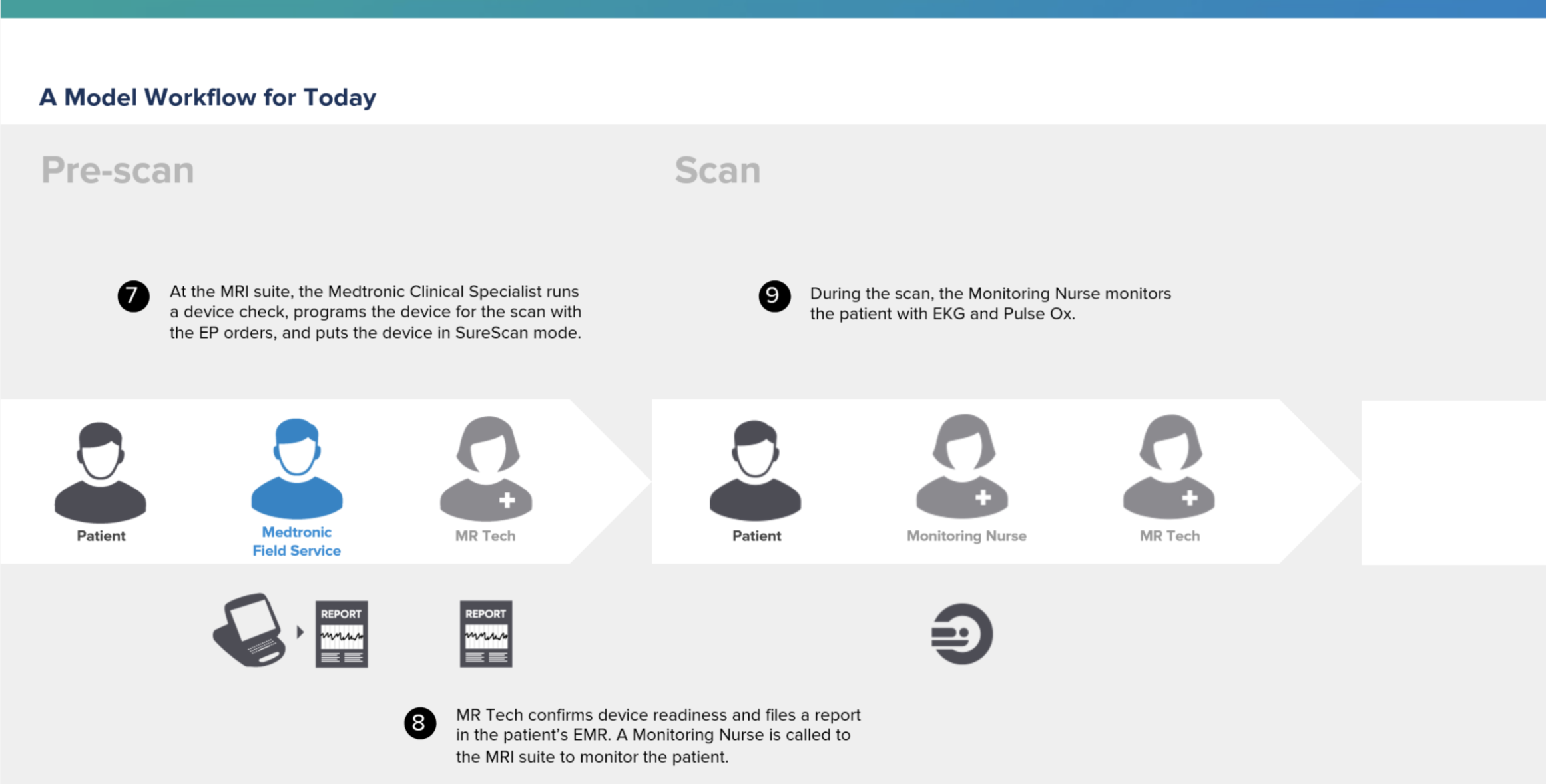
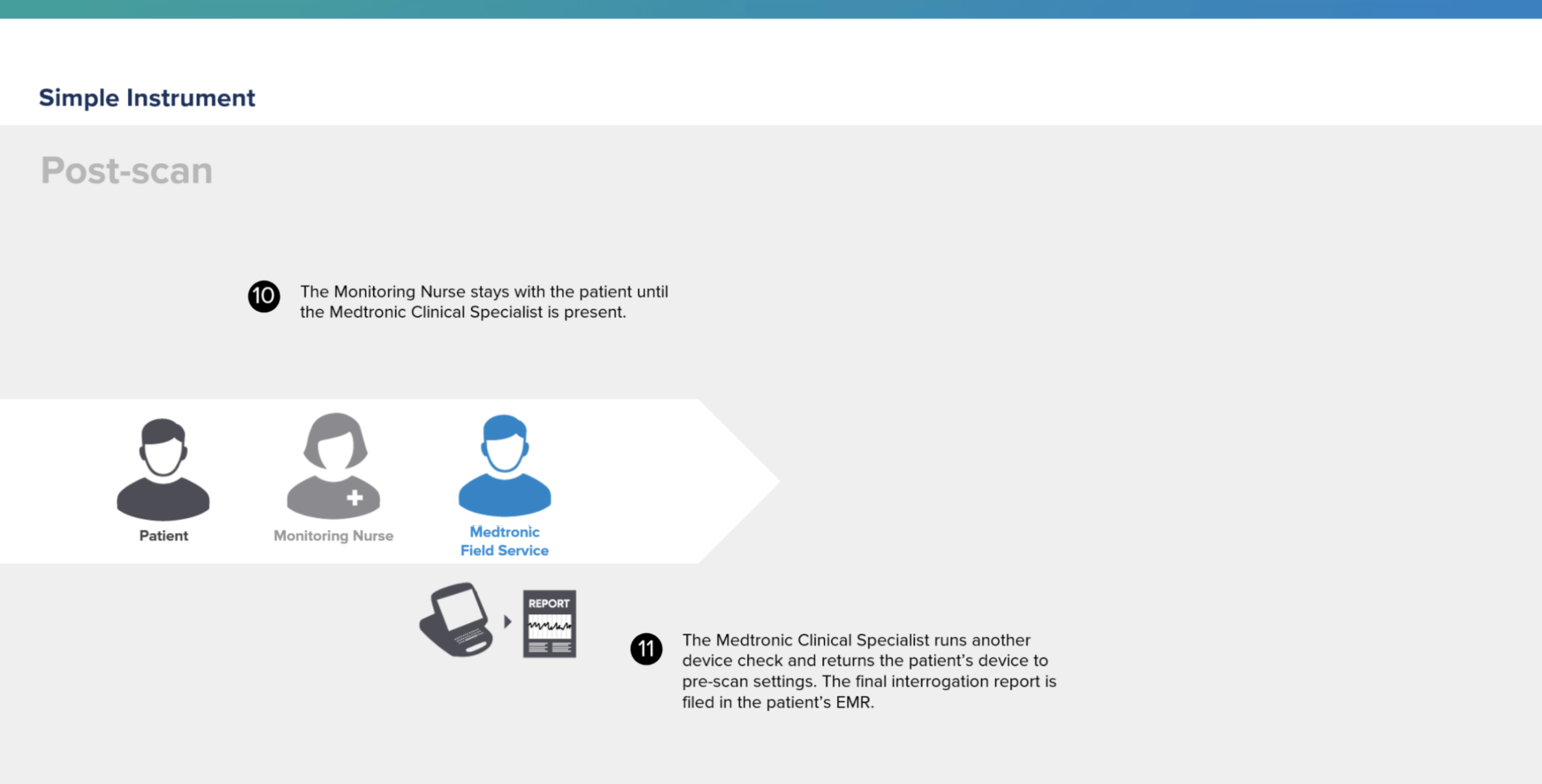
Steps 1–6 · MRI Referral & Approve & Schedule, referral routed through central scheduling, chart compiler, EP, and out to the Medtronic Clinical Specialist.
 Click to view full detail
 Click to view full detail
Figure 05
Change management, bringing the field team along, role by role.
1 / 4
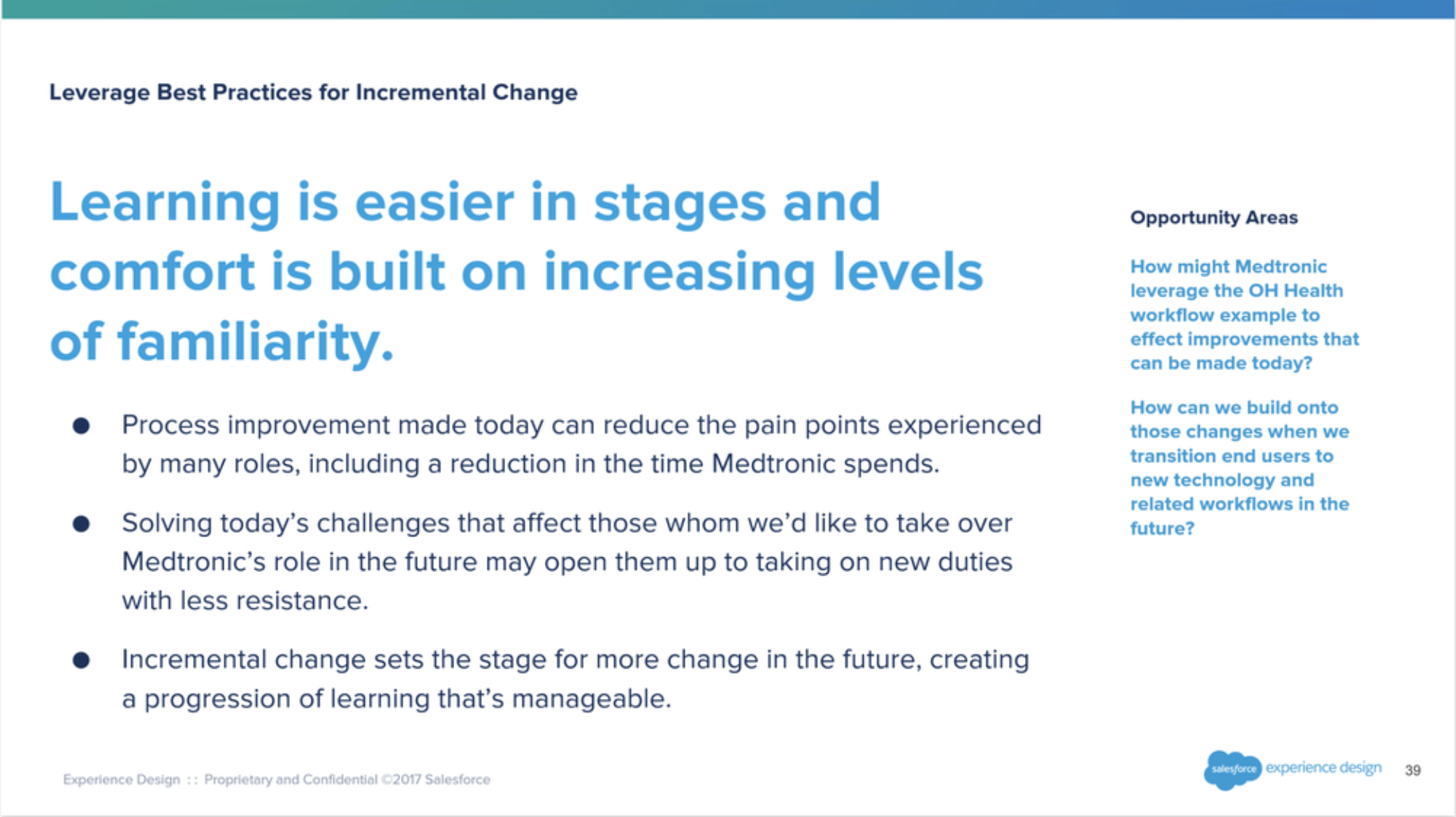
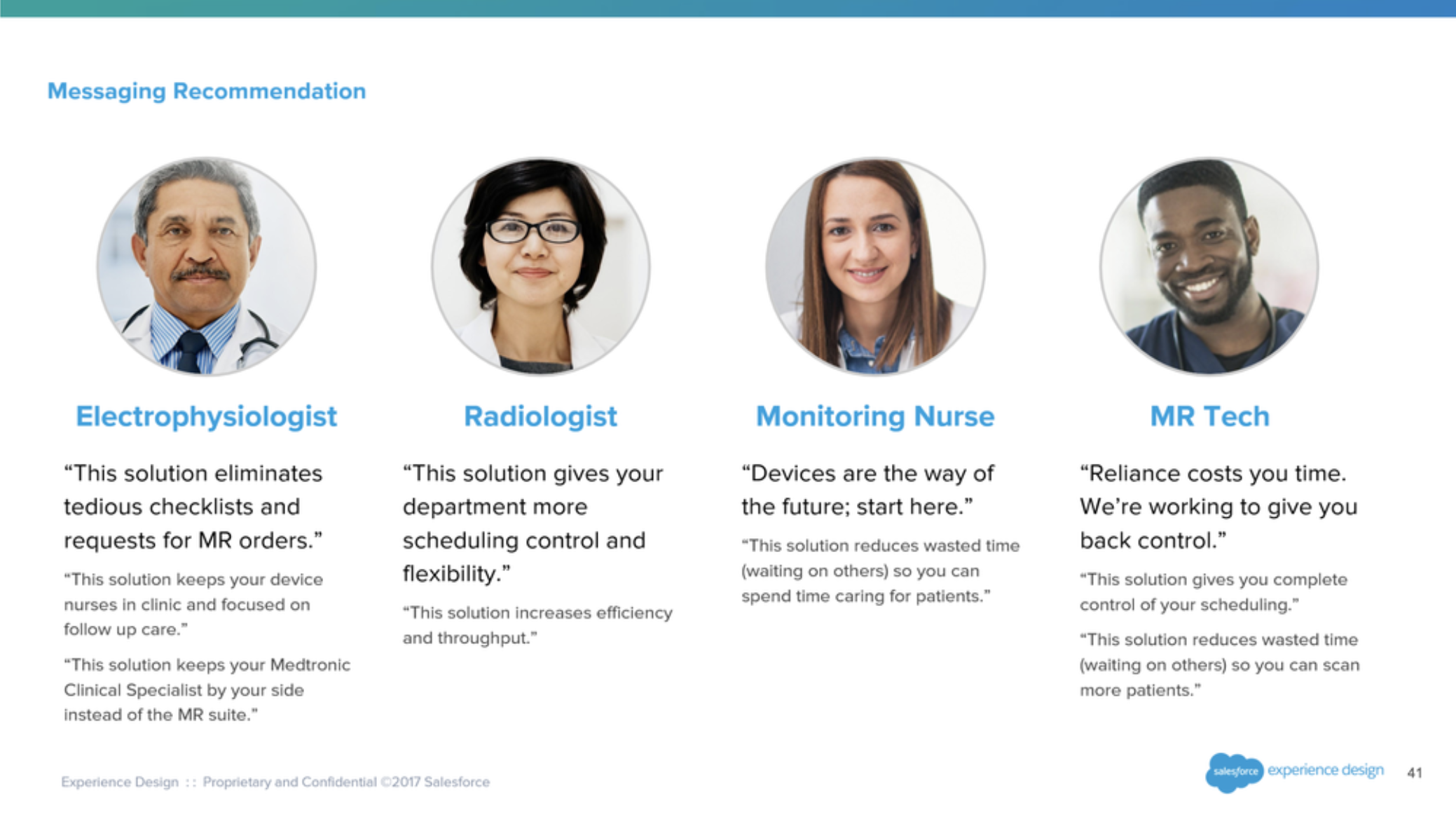
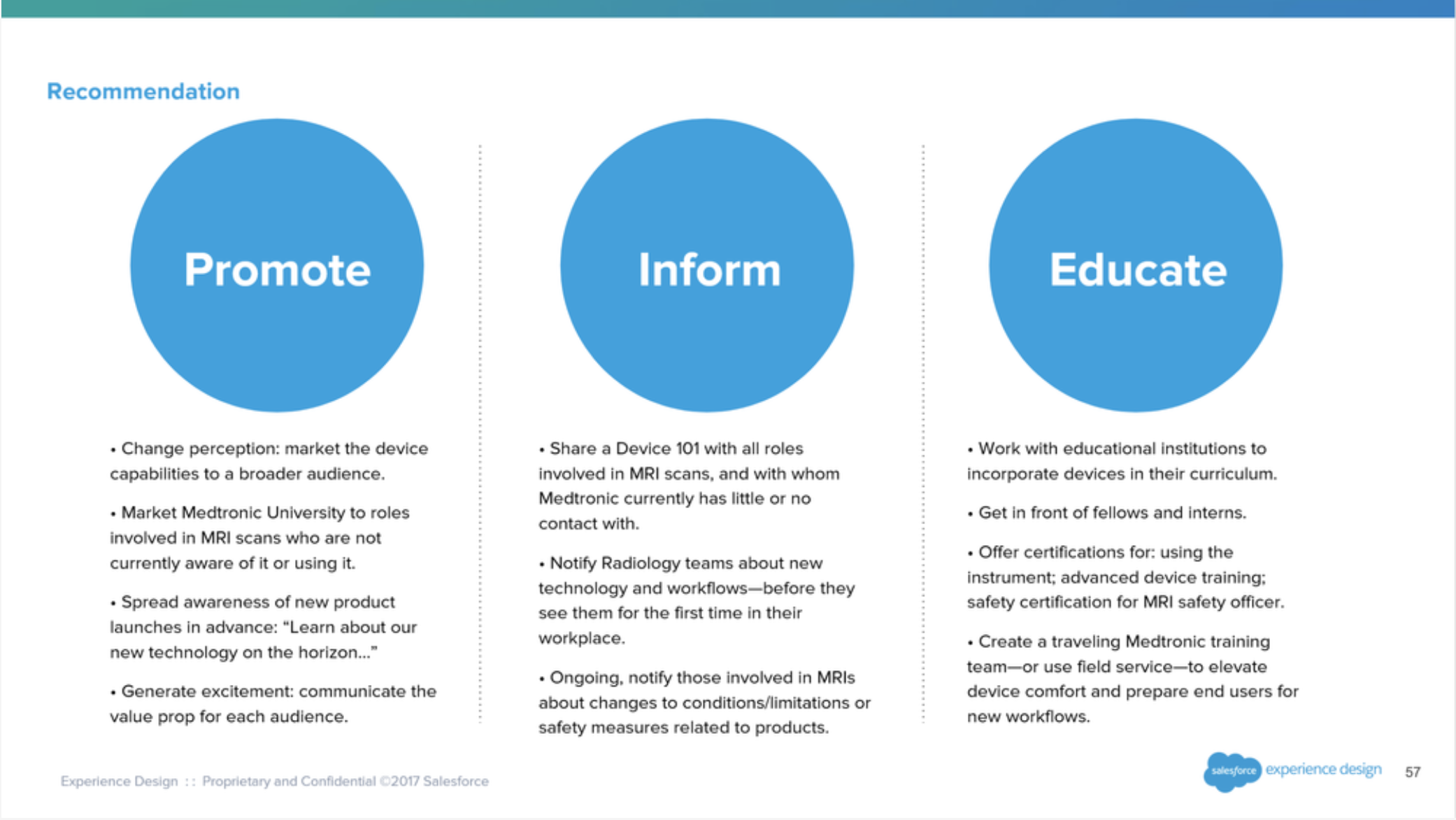
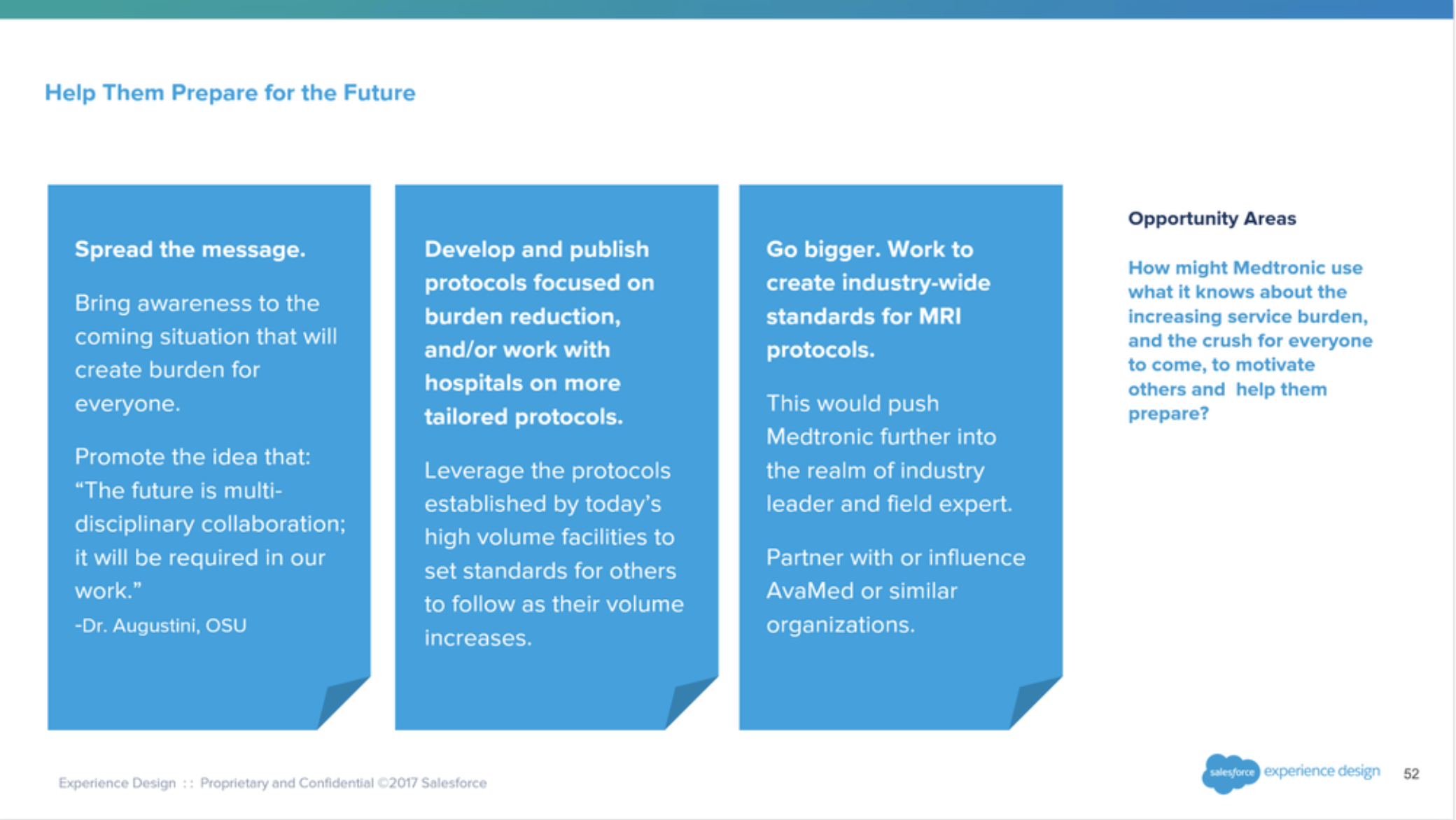
Principle · Learning is easier in stages, incremental change today sets the stage for bigger change tomorrow.
03 / Outcome
Findings integrated into Medtronic's MRI protocols, rolled out nationwide.
Impact
Our findings were integrated into Medtronic's MRI protocols and rolled out nationwide, pairing short-term workflow changes the field team could adopt immediately with a longer-term hardware-and-service concept.
The work gave Medtronic's Customer Experience team a clear, role-by-role picture of where service burden was being absorbed today, and a defensible plan for moving more of that work back into the facility.