Case study · 01 of 05

The future of Marketplace — benchmarking and vision for Autodesk's Solution Buyers.

Client
Autodesk
Role
Strategic Design Lead
Year
2025
Disciplines
Strategy · Trends Research · Benchmarking

To grow from $5B to $10B in revenue, Autodesk needed to uncover new ways to deliver value, advance creative capital, and unlock new revenue streams — and a third-party marketplace was a central part of that thesis.

I partnered with Autodesk's strategy team to define the experience for Solution Buyers — researching trends, benchmarking marketplace leaders, and recommending the principles to anchor a multi-year build.

The Problem

Without a marketplace, the experience fragments on both sides.

Two-sided gap

For Solution Buyers, Autodesk's core products are easy to purchase via self-serve touchpoints — but finding and implementing extended product solutions is difficult, and opportunities to inspire and advance creative value are lost.

For Solution Builders, operating outside Autodesk's platform creates integration and support friction, makes solutions hard to discover, and starves the data flywheel that would otherwise drive innovation and shared revenue.

Without a marketplace, Autodesk risks inconsistent experiences, fragmented workflows, and missed opportunities to capitalize on the flywheel of innovation and shared revenue from third-party solutions.
How might we unlock new revenue streams and expand customer value through a third-party marketplace that extends Autodesk's core platform?
Focus

We focused on the Solution Buyer's journey across the phases where a marketplace experience could move the needle: Discover · Consider · Buy · Onboard · Use · Extend.

"As a Solution Buyer, I identify potential solutions for my organization's challenges, work with a technical committee to evaluate, and coordinate with a buying committee to purchase. Post-purchase, I'm accountable for ensuring business outcomes are achieved."

$2B
Marketplace opportunity within a $5B → $10B growth target
6
Marketplace leaders benchmarked across industries
5
Strategic recommendations to anchor the build
01 / Trends

Forces of change — what's pulling marketplaces forward right now.

Method

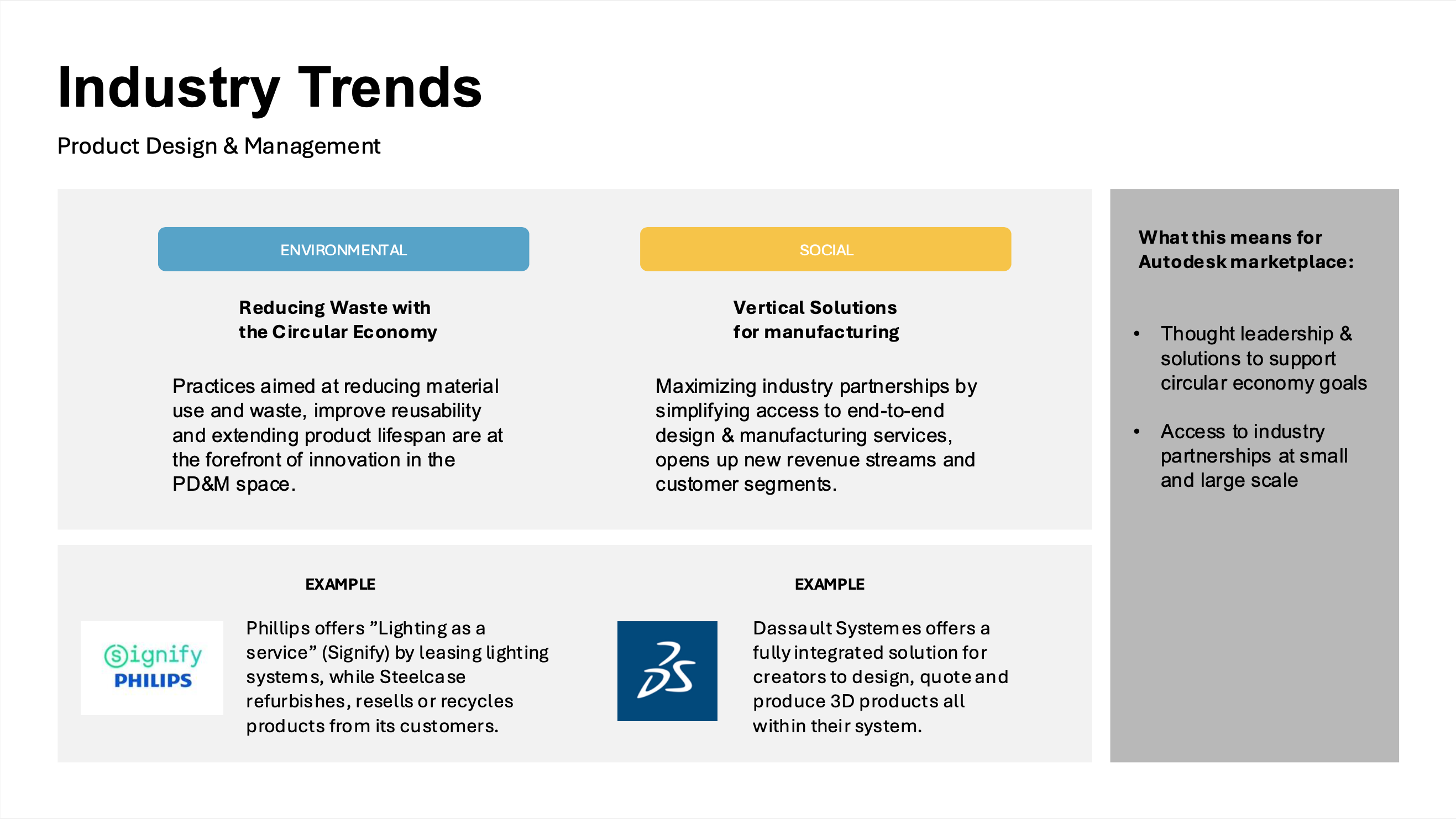
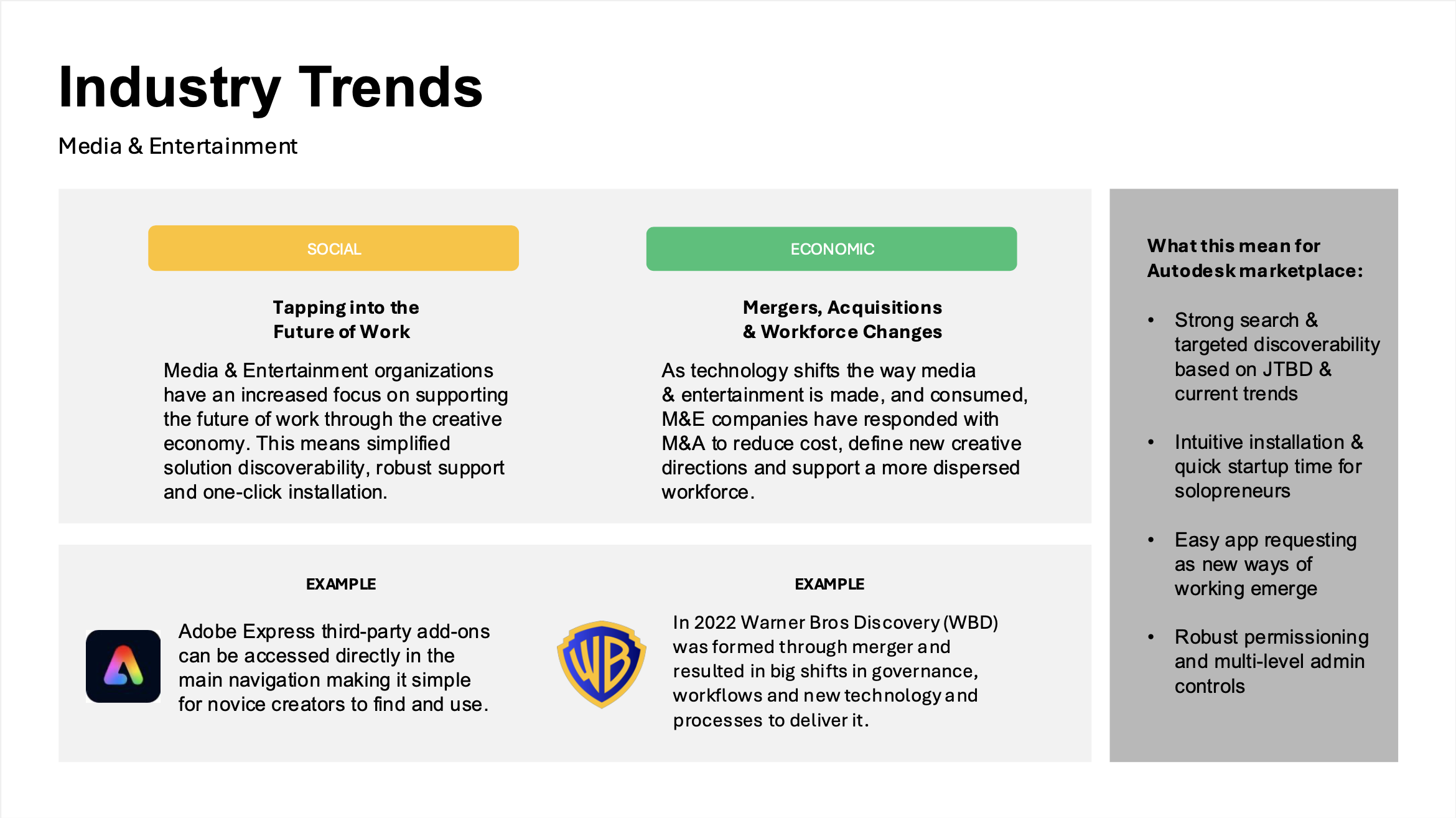
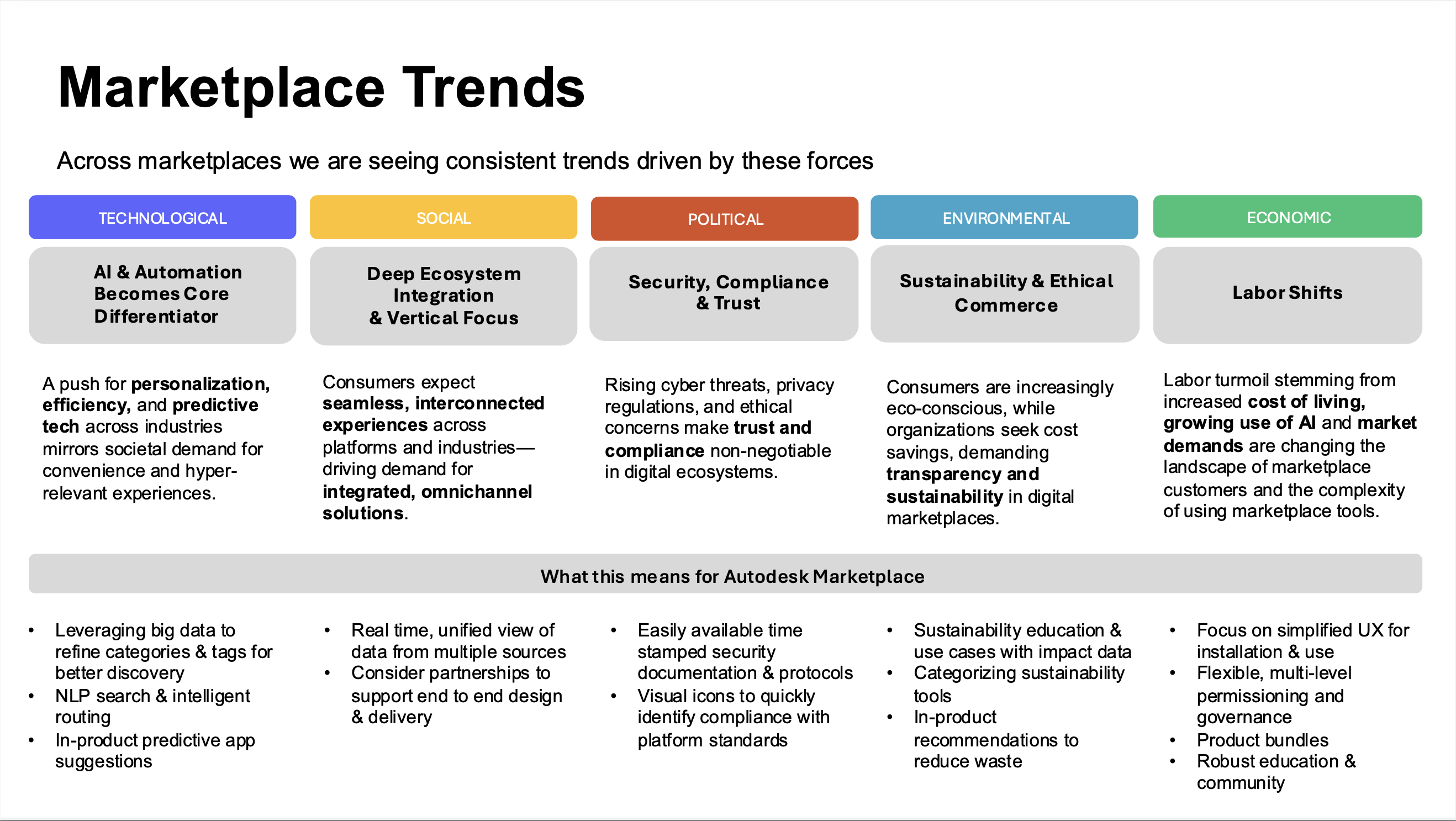
We researched business trends across industry verticals — Architecture, Engineering & Construction; Product Design & Manufacturing; and Media & Entertainment — against macro societal, technological, political, environmental, and economic forces, then organized the synthesis under Autodesk's Strategic Foresight forces-of-change framework.

Five marketplace-defining trends emerged across all three verticals.

AI & automation as a core differentiator

A push for personalization, efficiency, and predictive technology — leveraging big data to refine categories and tags, NLP-powered search, and in-product predictive app suggestions.

Deep ecosystem integration & vertical focus

Consumers expect seamless, interconnected experiences across platforms — real-time unified views, and partnerships supporting end-to-end design and delivery.

Security, compliance & trust

Rising cyber threats, privacy regulations, and ethical concerns make trust and compliance non-negotiable. Time-stamped security documentation and visual compliance signals become table stakes.

Sustainability & ethical commerce

Sustainability education and use cases with impact data, categorized sustainability tools, and in-product recommendations that reduce waste.

Labor shifts & the future of work

Increased cost of living, growing use of AI, and market shifts are changing who marketplace customers are. Simplified UX, flexible multi-level permissioning, product bundles, and robust education matter more than ever.

Industry-specific signals

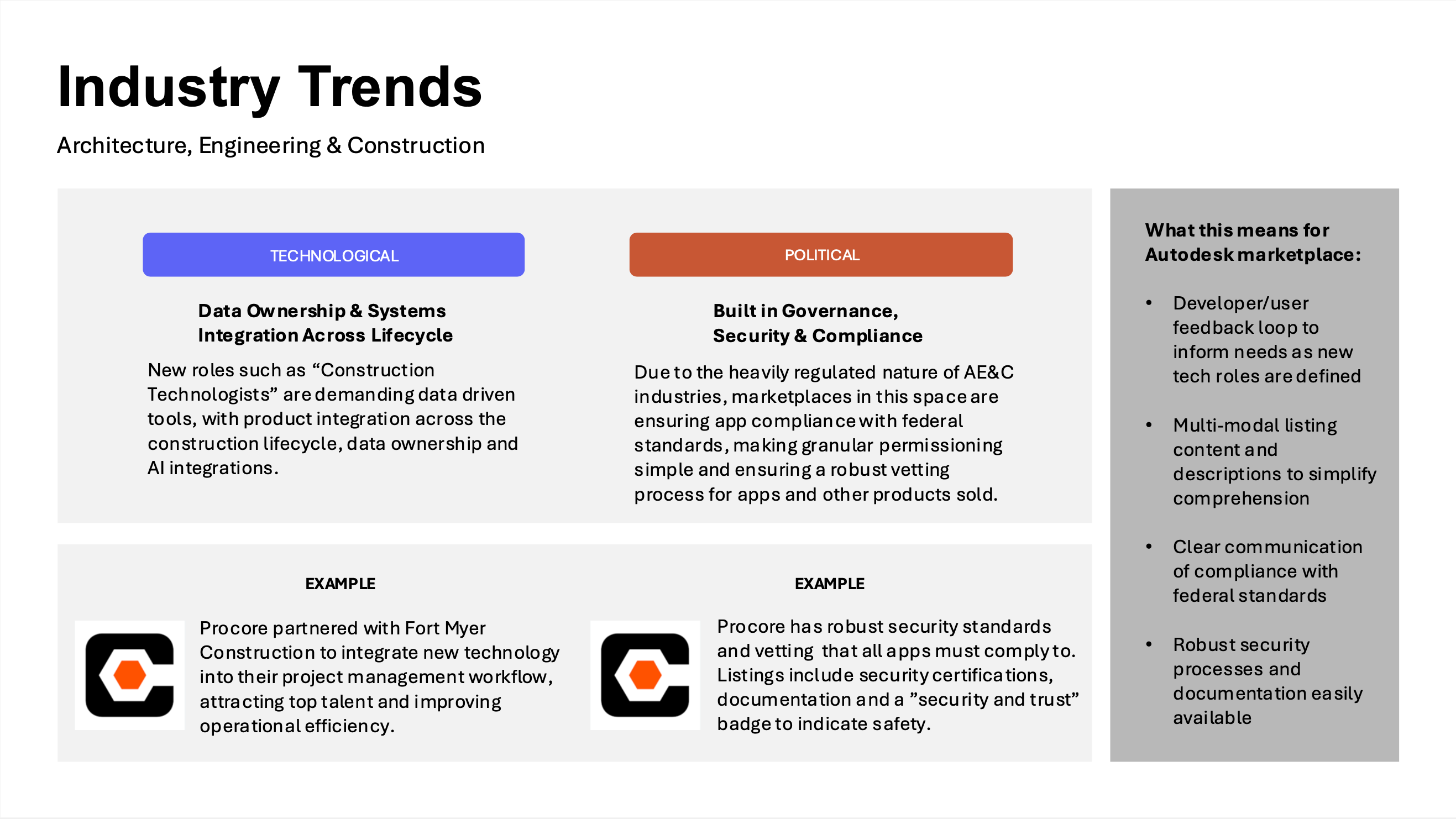
"Construction Technologists" demanding lifecycle integration in AE&C. Circular-economy practices reshaping PD&M. M&A and the creator economy reshaping Media & Entertainment.

02 / Benchmarking

Rating six marketplace leaders against what good looks like.

Approach

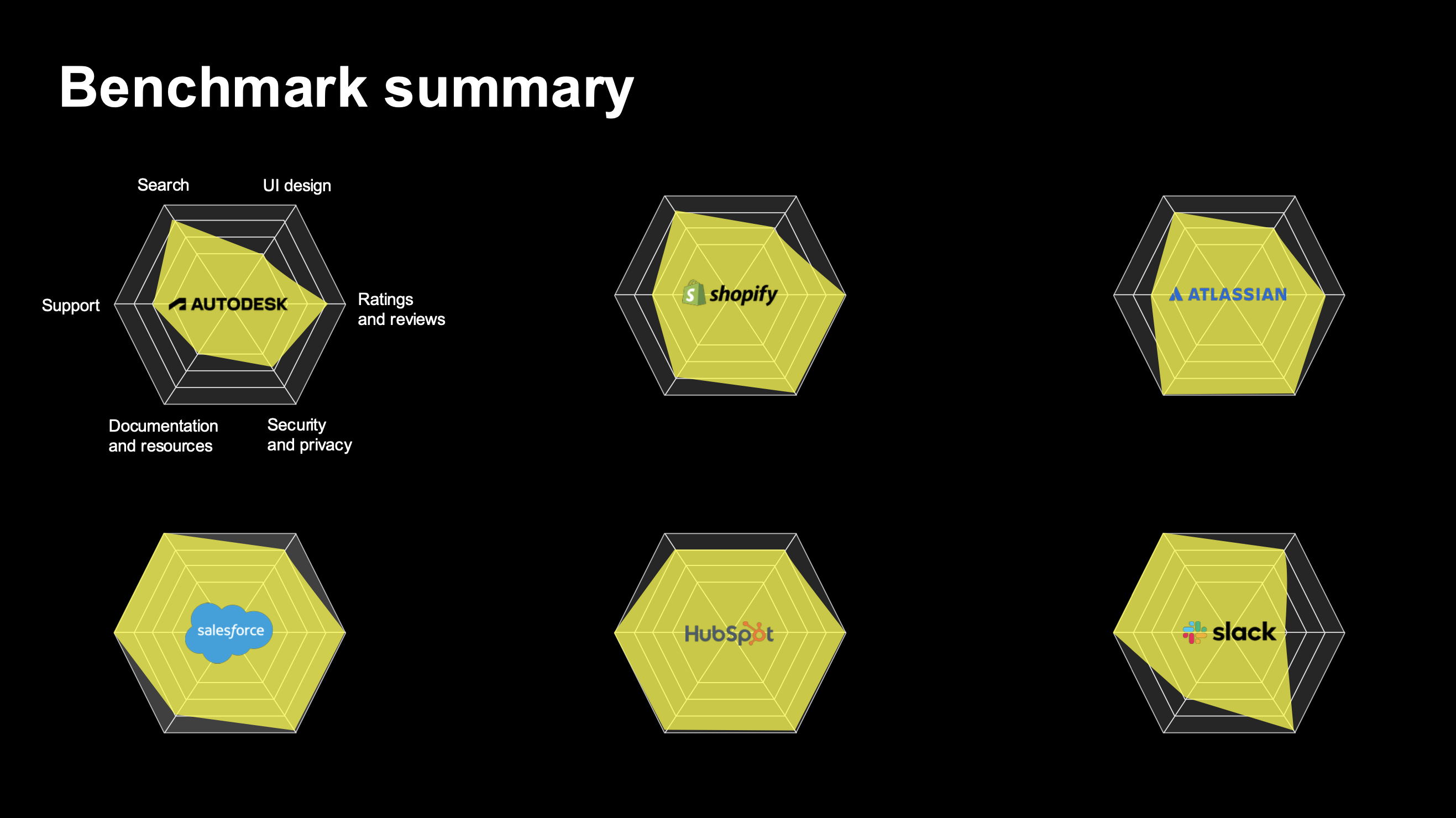
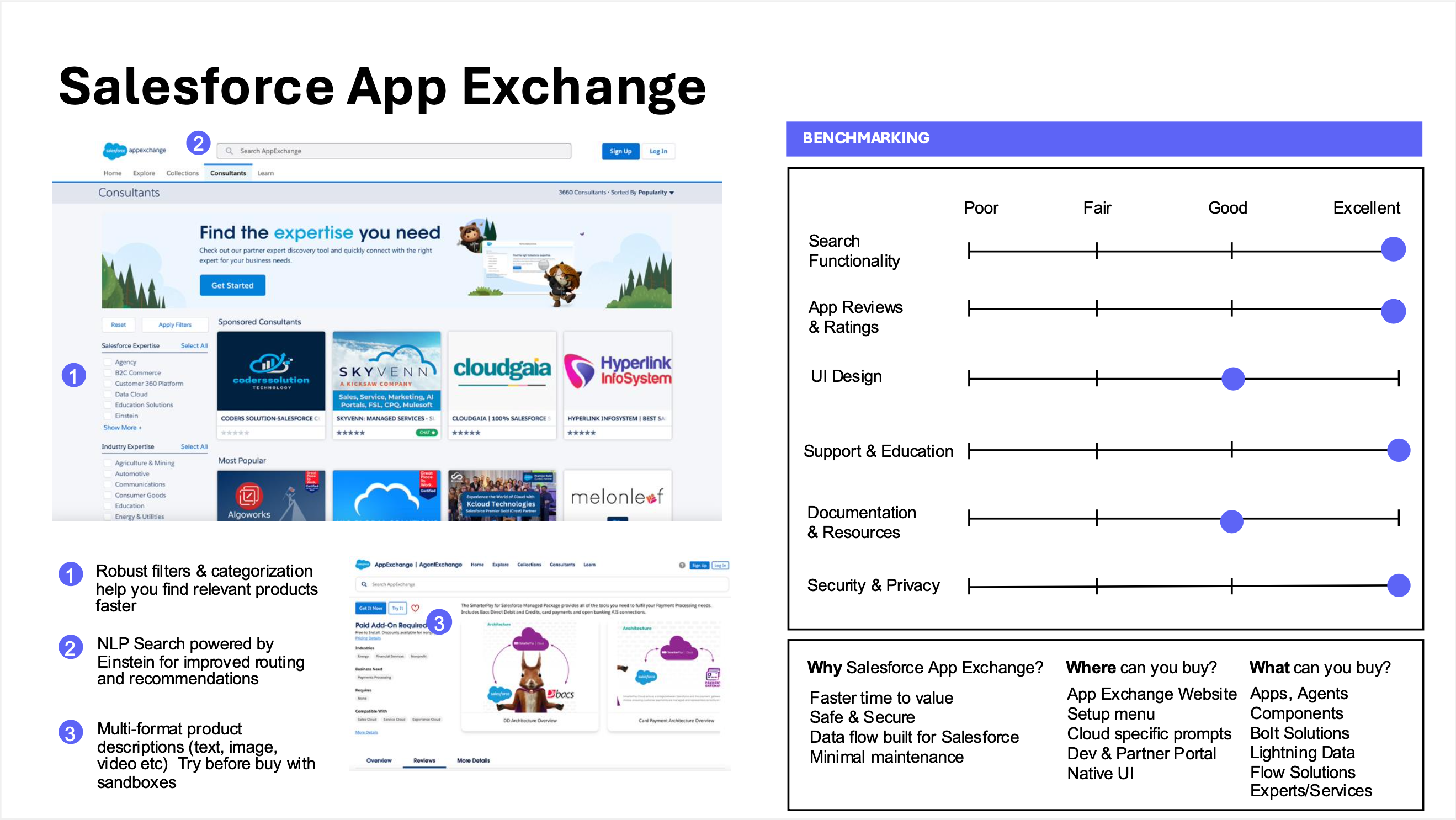
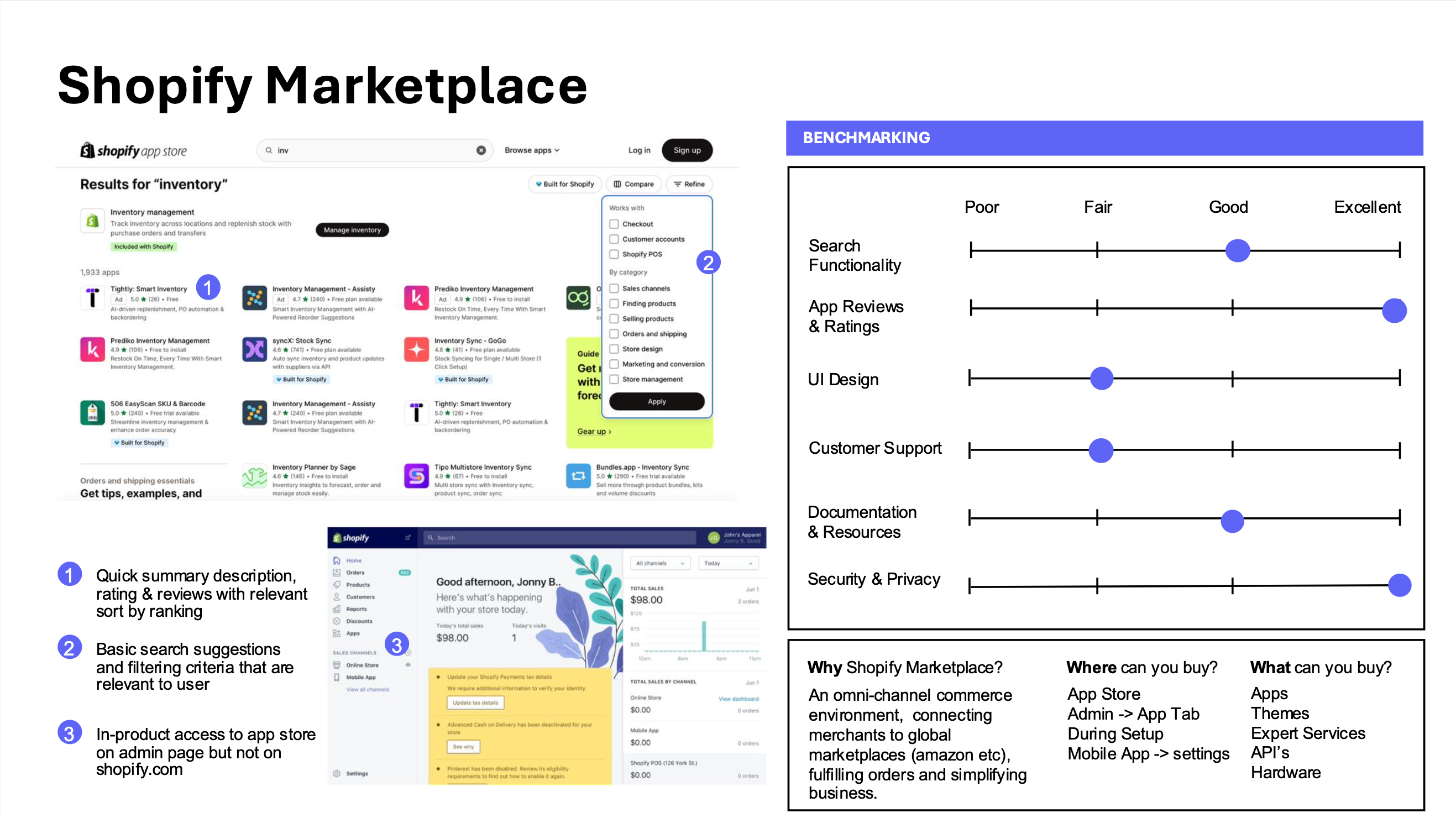
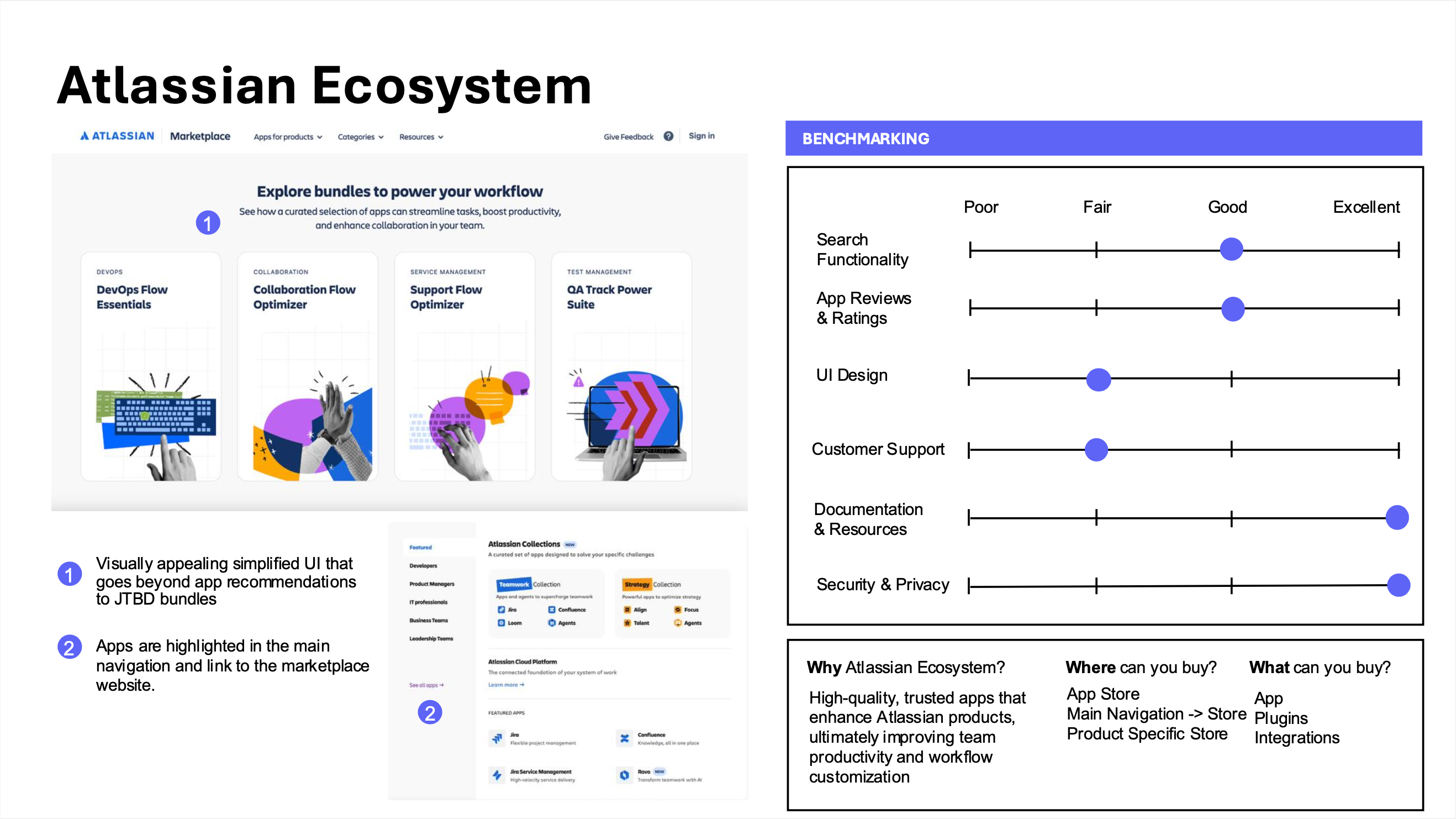
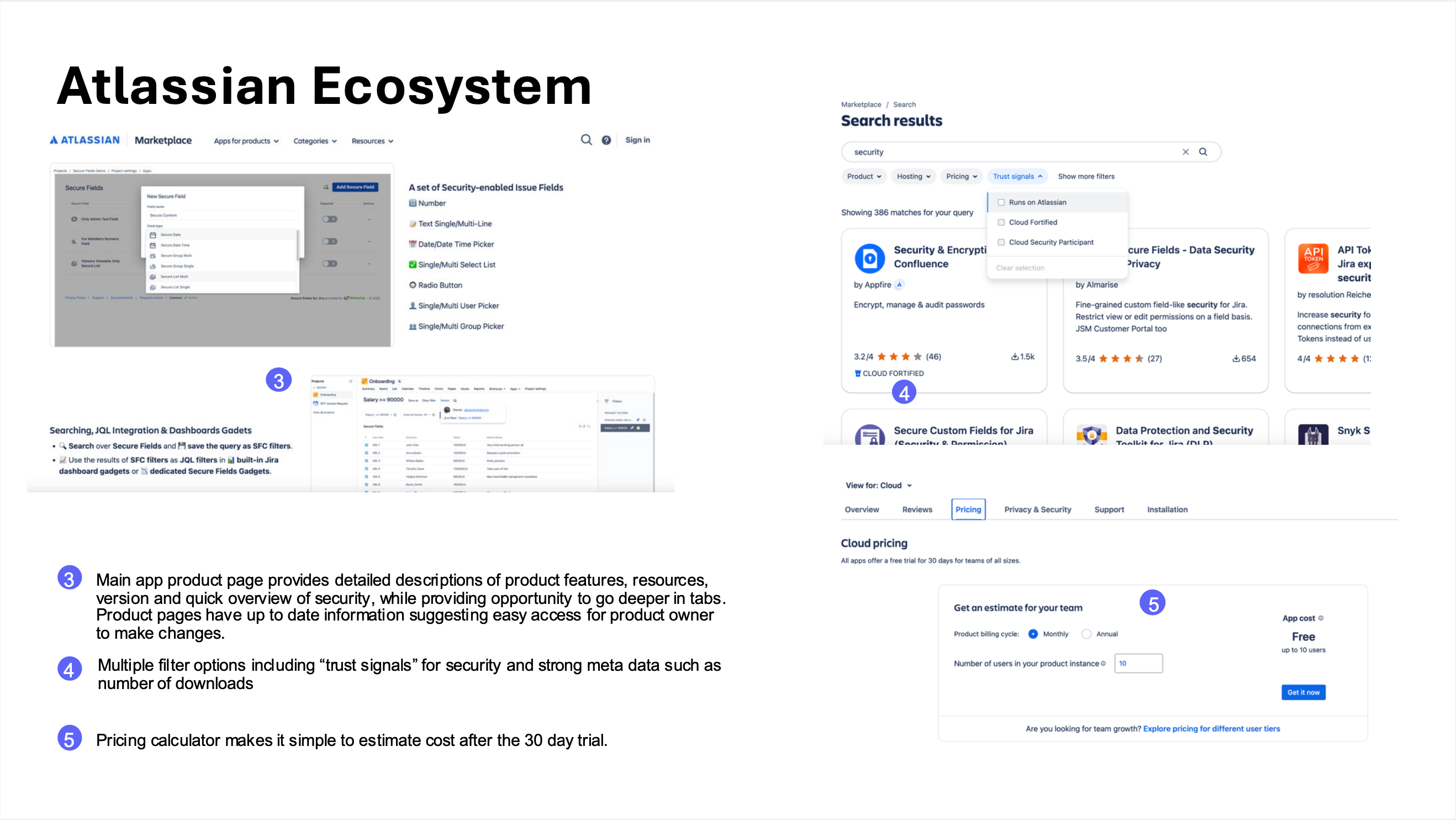
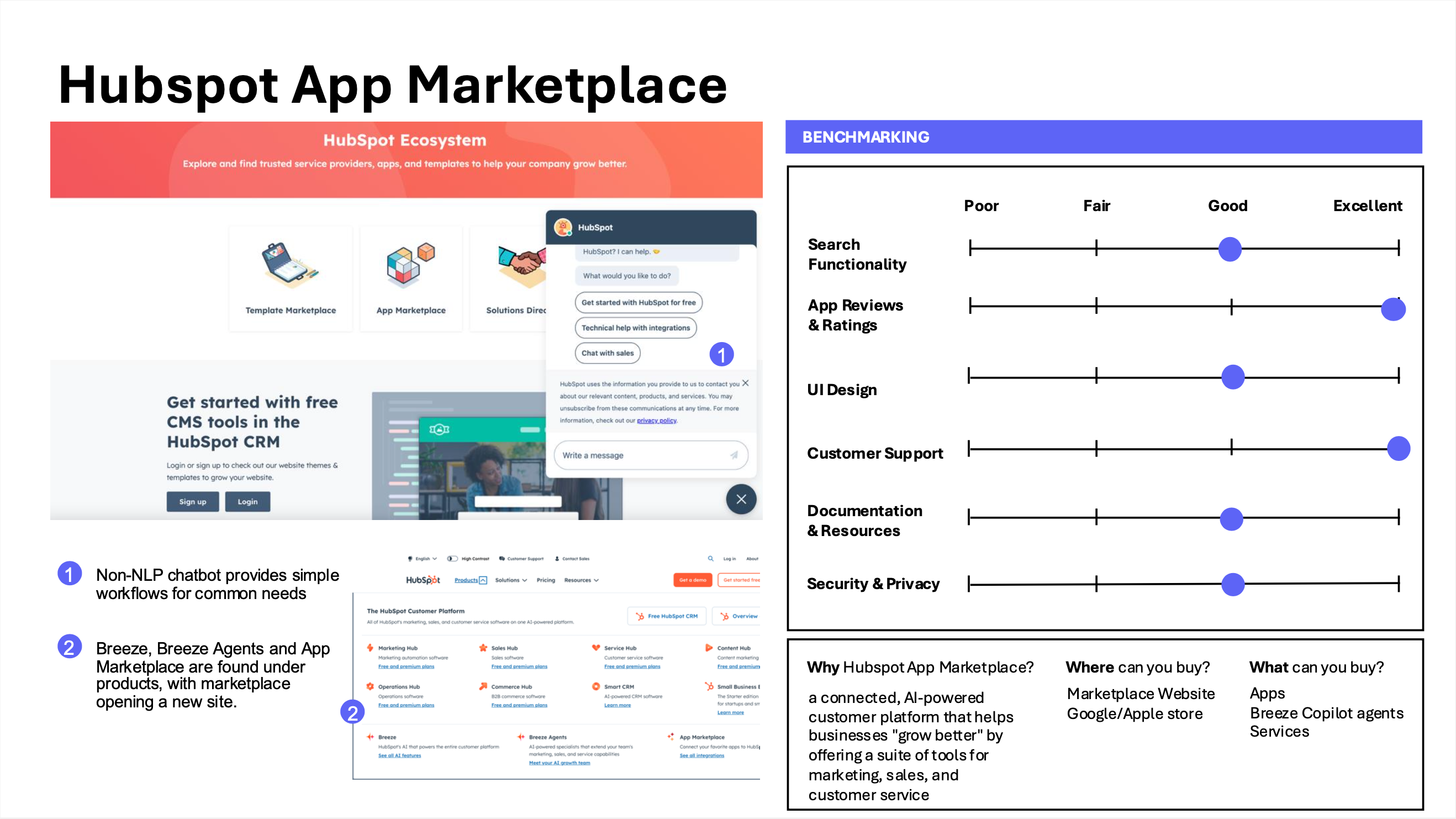
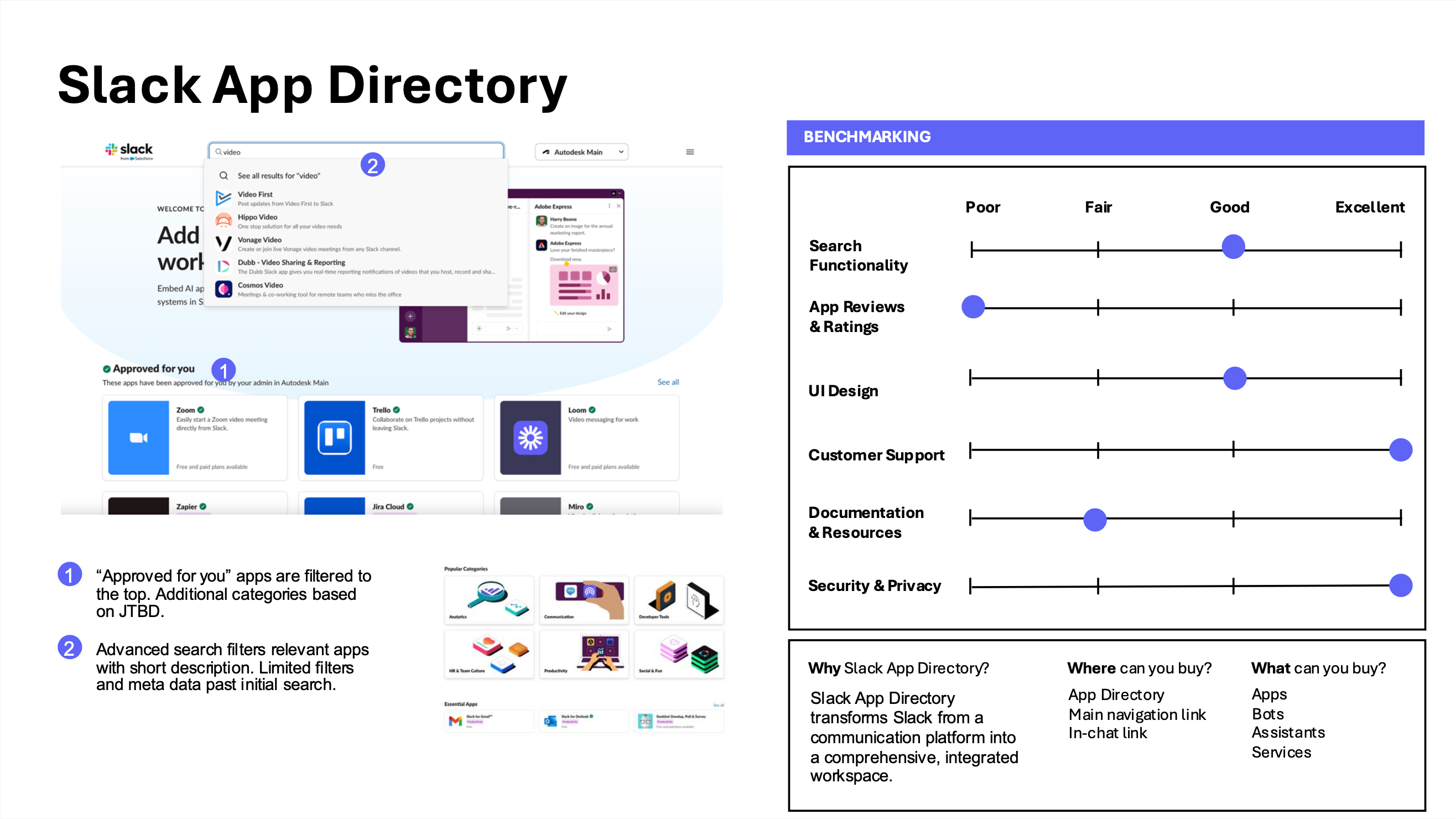
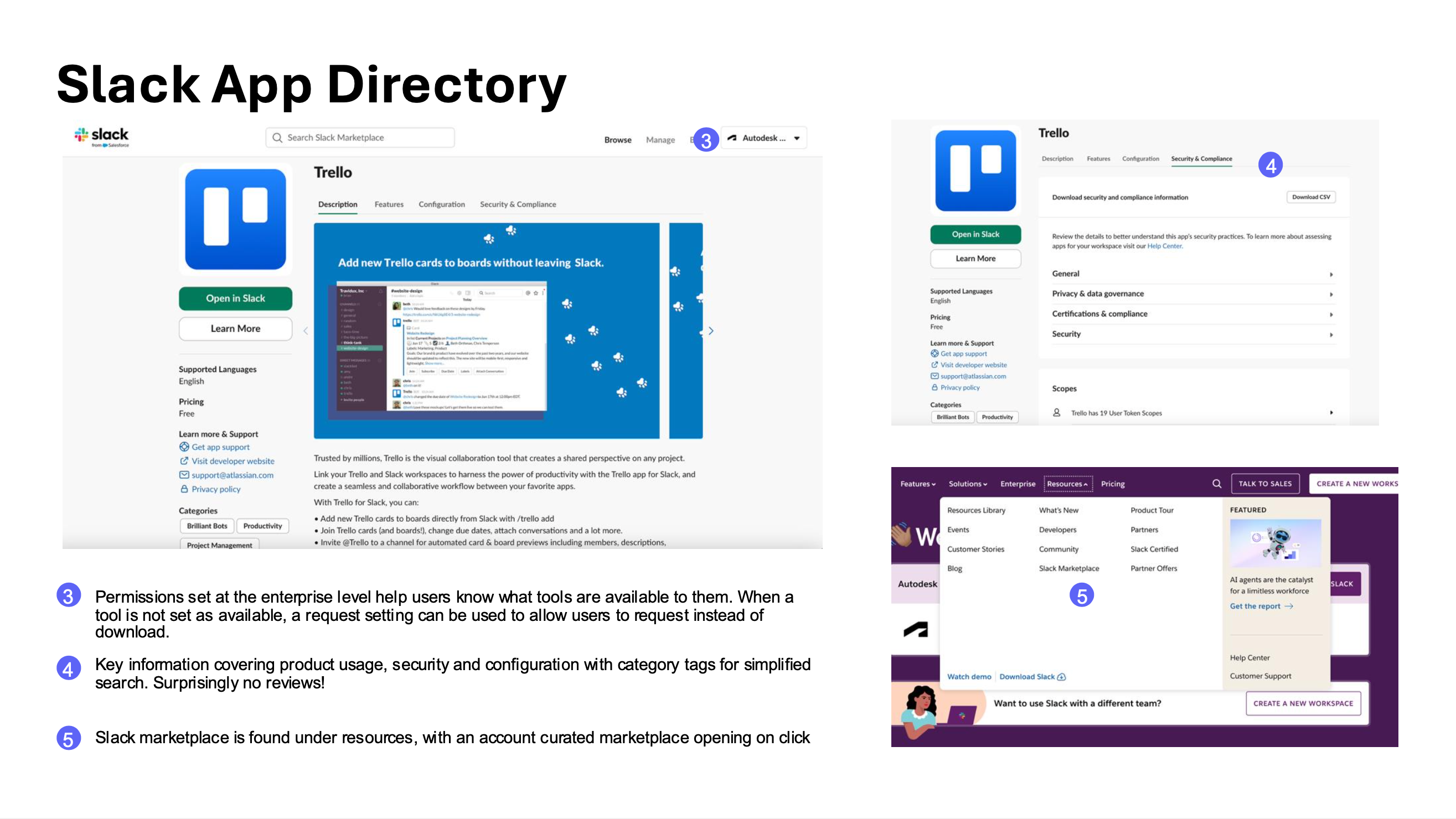
We selected six companies for their innovation and leadership in the marketplace model — Salesforce AppExchange, Shopify, Atlassian, HubSpot, Slack, plus Autodesk's current state as a baseline — and rated each on a four-point scale across six criteria:

  1. Search functionality
  2. Reviews & ratings
  3. UI design
  4. Customer support
  5. Documentation & resources
  6. Security & compliance
Benchmark summary — six radar charts on a black background comparing Autodesk against Salesforce, Shopify, Atlassian, HubSpot, and Slack across six axes: Search, UI design, Ratings and reviews, Security and privacy, Documentation and resources, and Support. Autodesk's footprint is the smallest; Salesforce, Atlassian, and HubSpot are the most well-rounded; Slack scores high on most axes but dips on Ratings and Documentation. Click to view full detail
Figure 02 Benchmark summary — Autodesk vs. five marketplace leaders across six axes.
Top takeaways
  1. Multiple entry points — admin, setup, chat, in-product — all pointing back to a single marketplace platform for search & purchase.
  2. Platforms support a range of digital products, services, and vertically-integrated physical solutions.
  3. Machine learning curates and surfaces app categories and recommendations so content stays relevant and inspirational.
  4. Permissions integrate seamlessly — communicating approved apps and enabling easy admin-side requesting.
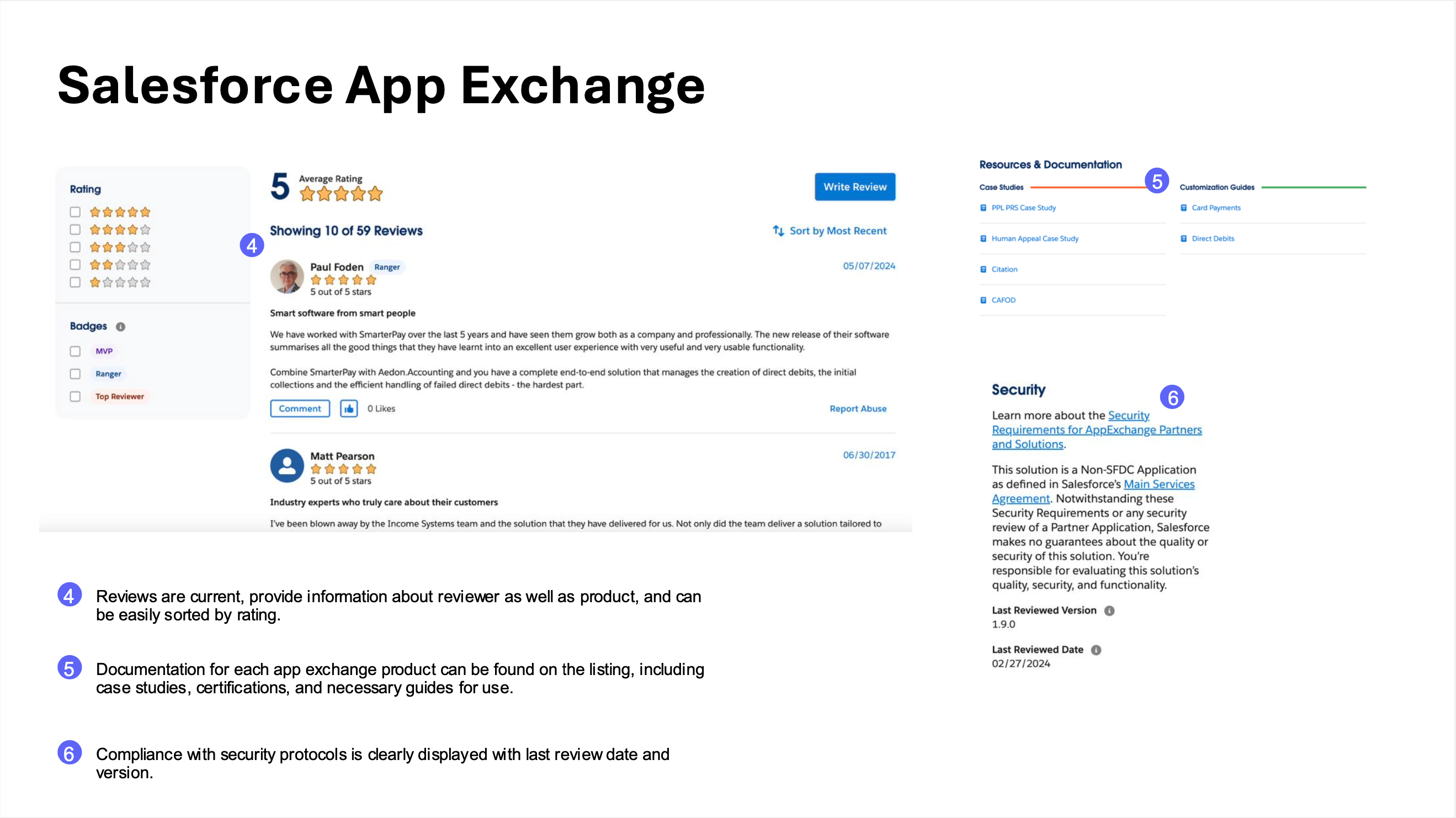
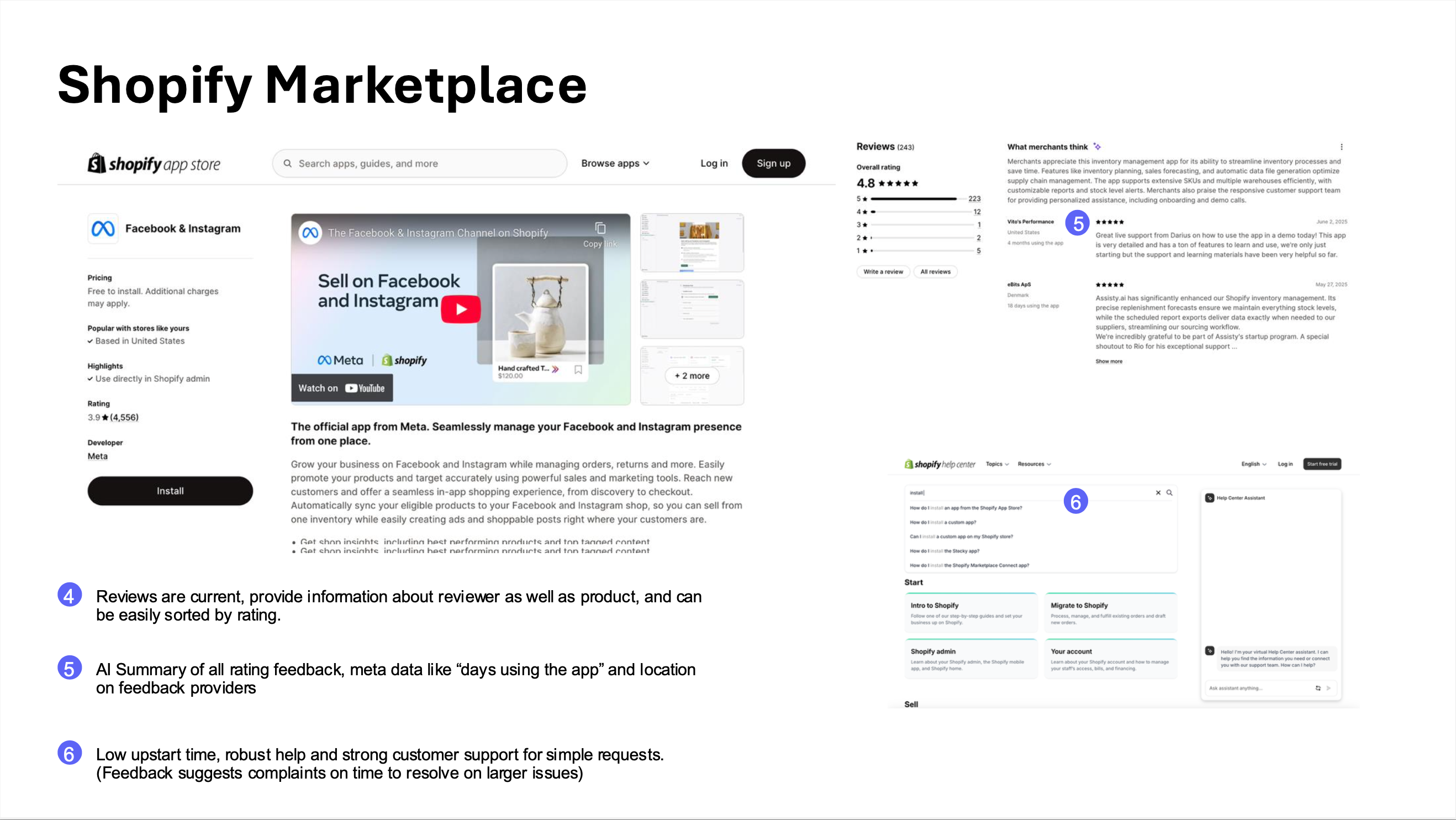
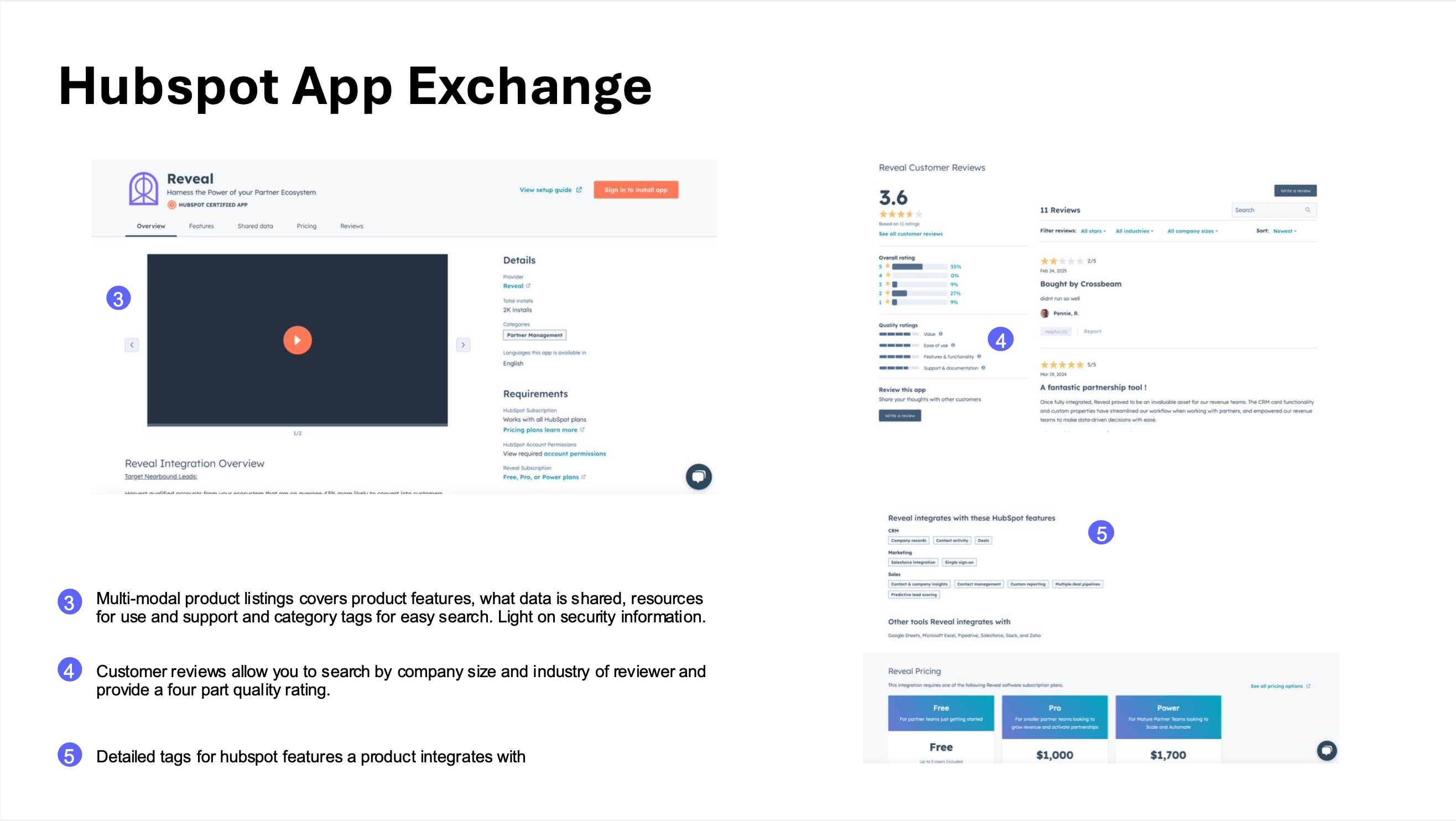
  5. Multi-modal descriptions with detailed documentation, security info, pricing, and customer support set the standard for best-in-class.
  6. Metadata and robust filtering — use case, security level, integrations, pricing — help users surface valuable content in search and reviews.
Benchmark artifacts delivered
  • Per-company tear-downs (Salesforce, Shopify, Atlassian, HubSpot, Slack) — what you can buy, where, and why
  • Annotated screenshots highlighting standout patterns by category
  • Scorecard with rationale per criterion
  • Cross-cutting takeaways for the Autodesk team
03 / Recommendations

Five principles for the future Autodesk Marketplace.

Strategic recs
  1. Establish Autodesk Marketplace as a catalyst for user-led innovation. Position the marketplace as a trusted partner in up-leveling how customers do business — helping them harness emerging tech they may not yet know how to access.
  2. Support a unified view that positions Autodesk as a centralized hub for creativity. Support APIs, apps, and add-ons within the product, and forge partnerships that bring ideas to life — embedding Autodesk as the hub of creative work.
  3. Clearly communicate security & compliance standards to establish trust. In a landscape where rising cyber threats and regulation make trust non-negotiable, security messaging is a core part of marketplace value — not a footnote.
  4. Empower customers' sustainability goals through education & tools. Provide education and category-specific recommendations for solving customer problems with a sustainability lens.
  5. Support the changing face of the creative economy with flexible solutions. Prioritize a simple, user-friendly path to productivity — with robust permissioning and touchpoints inside and outside the Autodesk ecosystem.
04 / Outcome

A research-backed direction the strategy team could build against.

Impact

We delivered a benchmarking and trends study, five strategic recommendations, a future-state Solution Buyer journey, and conceptual wireframes — the foundation the strategy team needed to align stakeholders and brief the next phase of work.

The framing — marketplace as catalyst, hub, trust layer, sustainability lever, and flexible front door — gave the team a shared language for evaluating every subsequent design decision against the $2B opportunity.

Next case study
Boeing