Case study · 02 of 05

Transforming Boeing's Global Services experience — a vision for OneBGS.

Client
Boeing Global Services
Role
Innovation Consulting Lead
Year
2024
Disciplines
Research · Strategy · Future Vision

Boeing Global Services set an ambitious target: grow to $50B in annual revenue by 2027 by becoming the only fully integrated aftermarket partner in commercial aviation.

But after years of growth-through-acquisition, BGS had become siloed — disconnected systems, isolated teams, and disjointed experiences for the customers it served. Salesforce partnered with Boeing to define a path forward, and I led the research and future-vision work.

The Engagement

A four-month sprint with one question: how do we propel sustainable digital transformation?

HMW

How might we propel sustainable digital transformation that delivers on our promise of OneBGS in order to grow revenue, improve operational efficiencies, and strengthen customer & employee experiences?

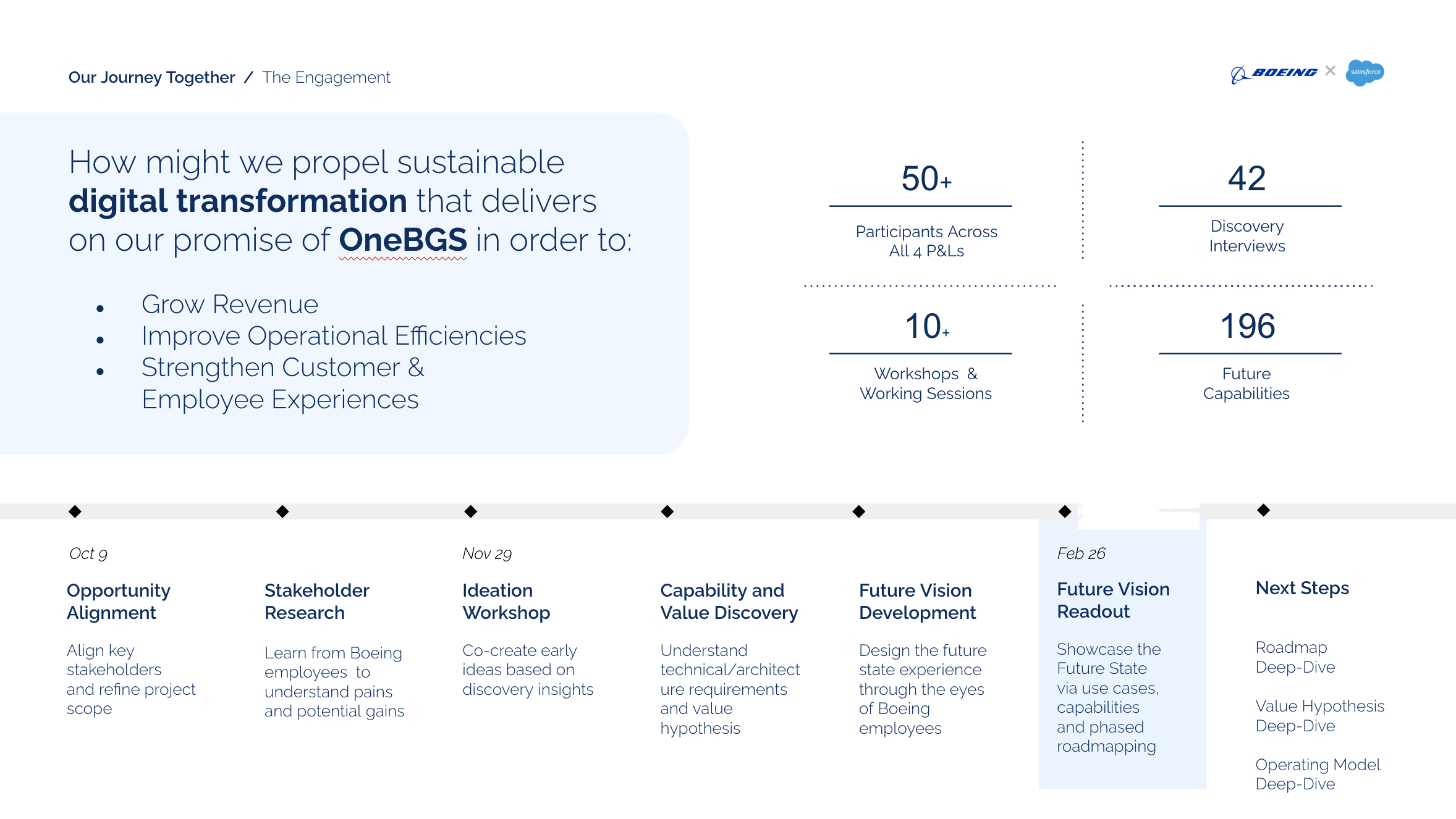
Together with the Boeing's BGS leadership across all four P&Ls (CMESP, P&DS, DAS, Training) and the Salesforce Sales team, the Salesforce Ignite team ran a structured engagement from opportunity alignment through future-vision readout.

50+
Participants across all four P&Ls
42
Discovery interviews with Boeing employees
10+
Workshops & working sessions, Oct → Feb
196
Future capabilities identified across the platform
Our Journey Together / The Engagement. Left side states the HMW: 'How might we propel sustainable digital transformation that delivers on our promise of OneBGS in order to grow revenue, improve operational efficiencies, and strengthen customer & employee experiences?' Right side surfaces the key stats: 50+ participants across all 4 P&Ls, 42 discovery interviews, 10+ workshops & working sessions, and 196 future capabilities. Bottom is a six-step timeline from Oct 9 to Feb 26: Opportunity Alignment (align stakeholders, refine scope), Stakeholder Research (learn from Boeing employees about pains and gains), Ideation Workshop (co-create early ideas from discovery insights), Capability and Value Discovery (technical/architecture requirements and value hypothesis), Future Vision Development (design future-state experience through the eyes of Boeing employees), Future Vision Readout (showcase the future state via use cases, capabilities, and phased roadmapping), and Next Steps (Roadmap Deep-Dive, Value Hypothesis Deep-Dive, Operating Model Deep-Dive). Click to view full detail
Figure 01 Engagement arc — Oct alignment → Feb future-vision readout.
01 / Research

A complex, siloed organization — and customers feeling it on the other side of the table.

What we heard

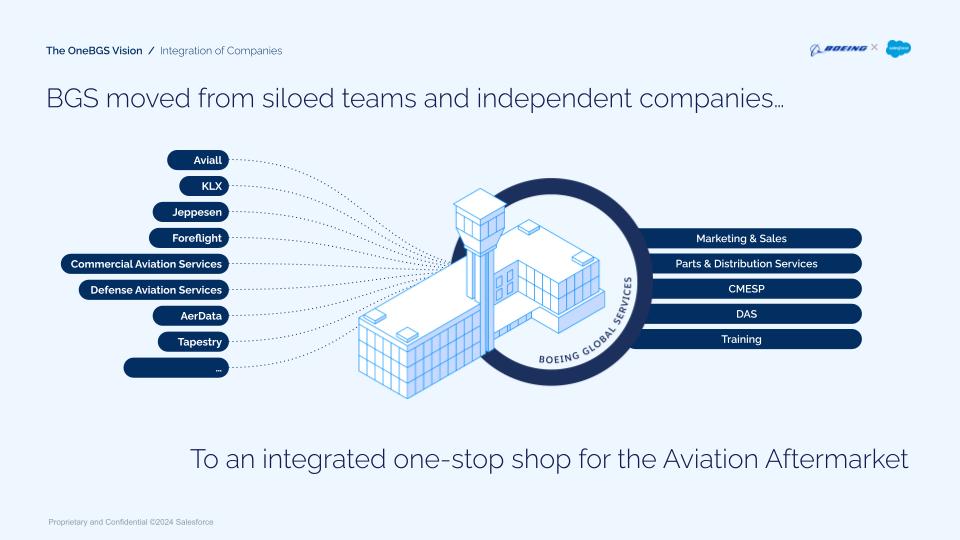
BGS was formed by merging Commercial Aviation Services (AerData, Aviall, Jeppesen), Defense Aviation Services (ForeFlight, KLX, Tapestry), Parts & Distribution, and Training under a single shop for the aviation aftermarket. The integration delivered scale — but at the cost of consistency.

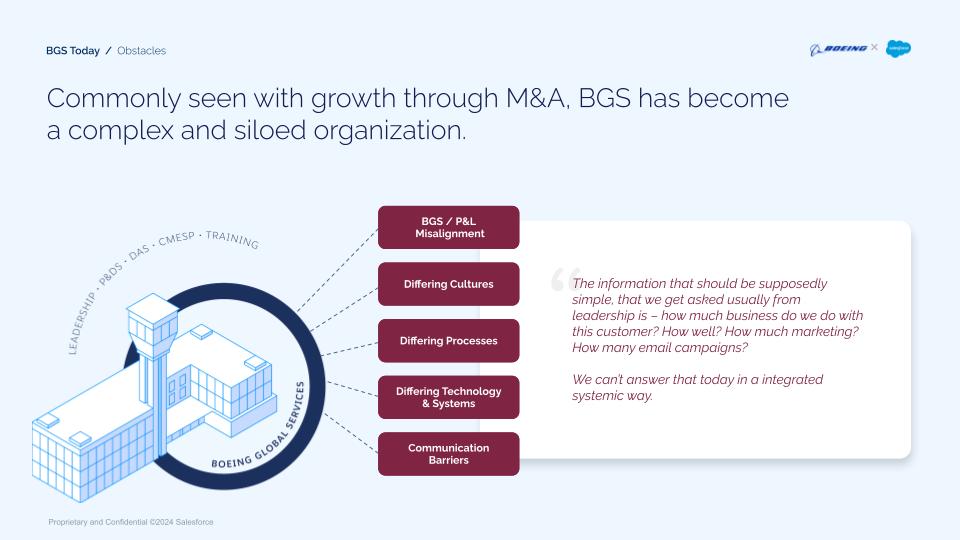
Through 42 interviews across leadership, marketing, sales, service, and IPT execution, four obstacles surfaced again and again:

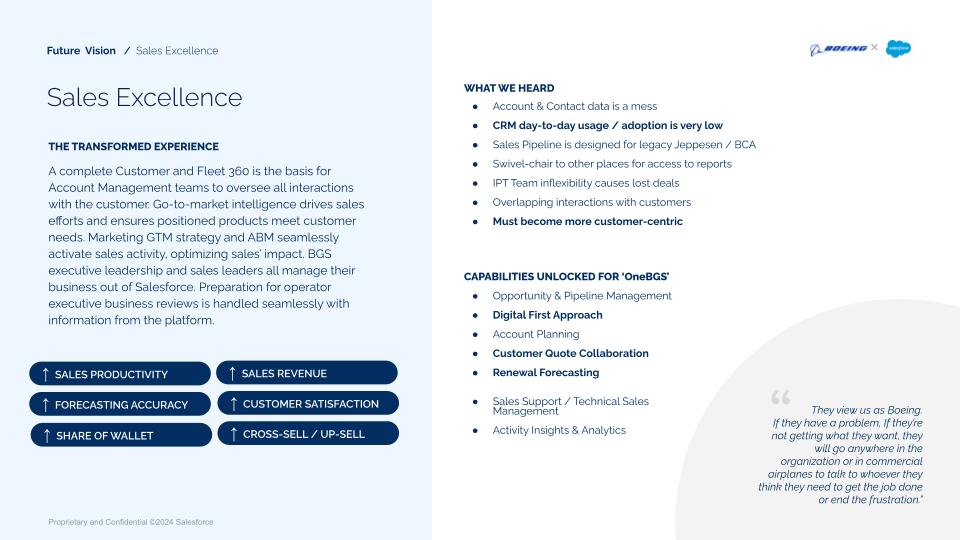
  1. Differing cultures, processes, and technology across P&Ls — communication barriers between teams that should be coordinated.
  2. Legacy tools and disconnected systems with data siloed inside each acquired company's stack.
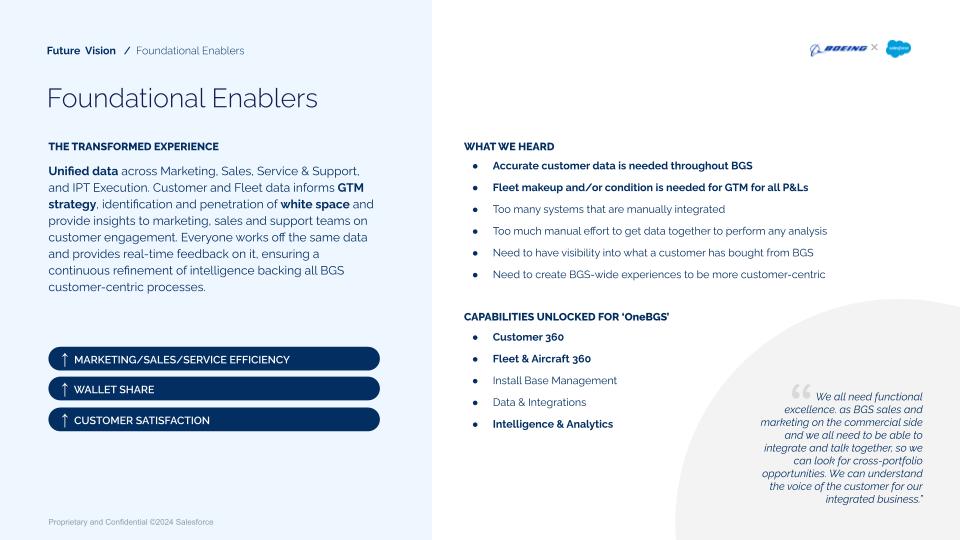
  3. Manual effort to answer basic questions — "How much business do we do with this customer? How many email campaigns?" — couldn't be answered in an integrated way.
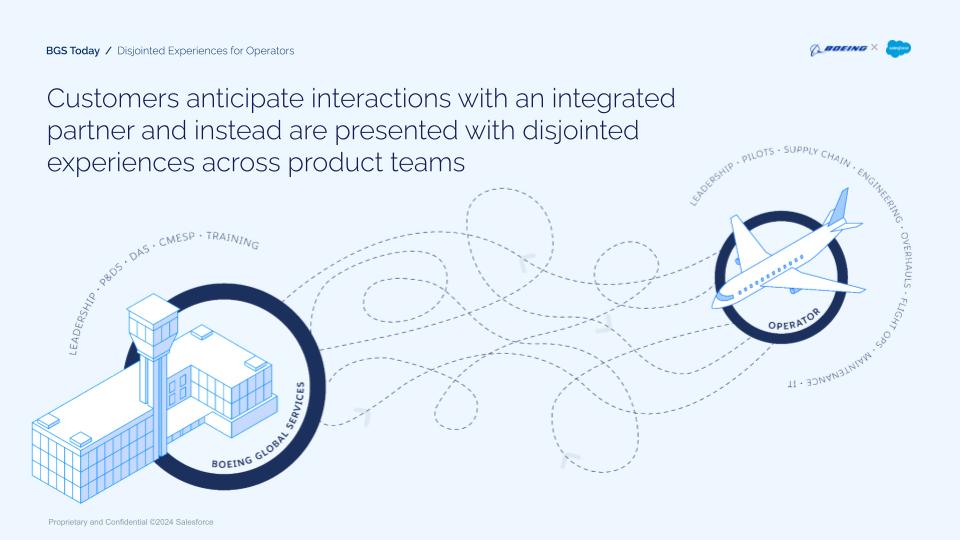
  4. Customers experiencing BGS as fragmented — overlapping, conflicting interactions across product teams when they expected one Boeing.
They view us as Boeing. If they're not getting what they want, they'll go anywhere in the organization to talk to whoever they think they need to end the frustration.
The opportunity

BGS holds about 1% of a $3.2T addressable market. It's well-positioned to extend its lead — but smaller, more nimble competitors are gaining ground. The team had aligned: customer centricity is the path forward. Our role was to define what that looked like.

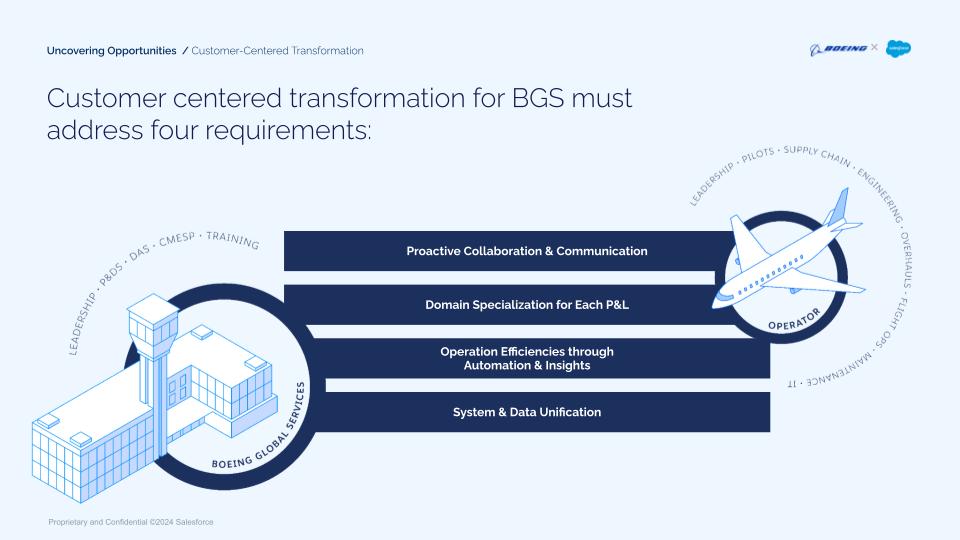
We framed customer-centered transformation across four requirements:

  1. System & data unification — one customer record, not a dozen.
  2. Operational efficiencies through automation & insights — free people from swivel-chair work.
  3. Proactive collaboration & communication — coordinate across P&Ls before the customer feels the gap.
  4. Domain specialization for each P&L — unify the customer experience without flattening the expertise.
02 / Future Vision

A platform approach built on a shared foundation — then four excellences on top.

The model

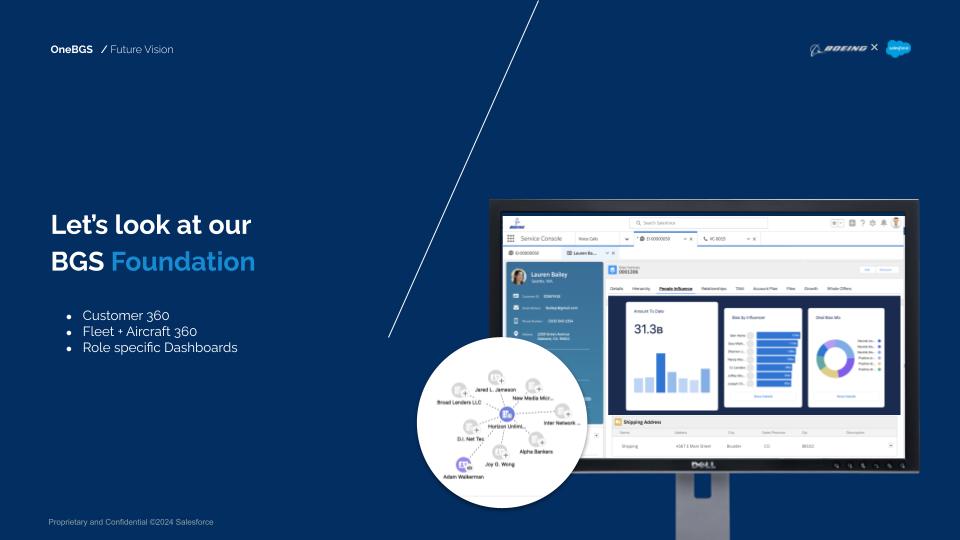
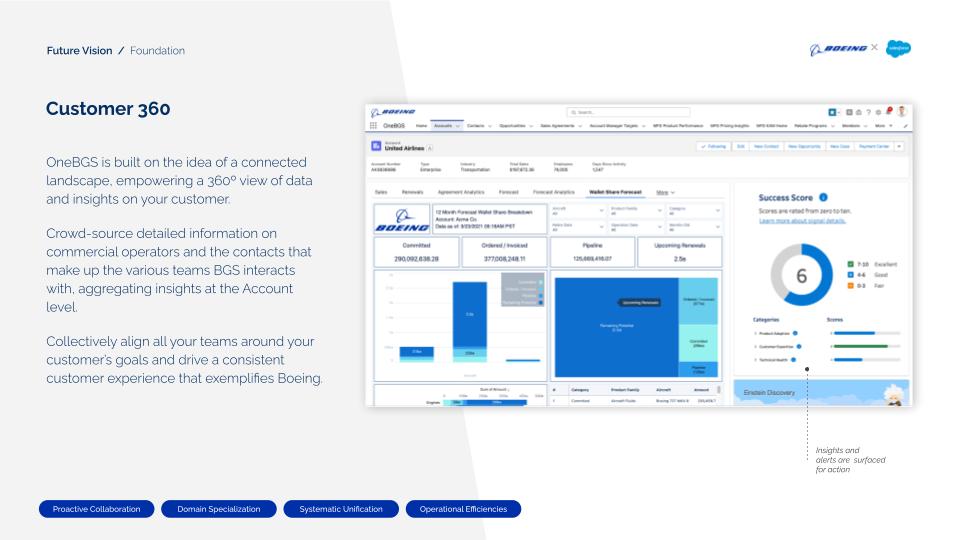
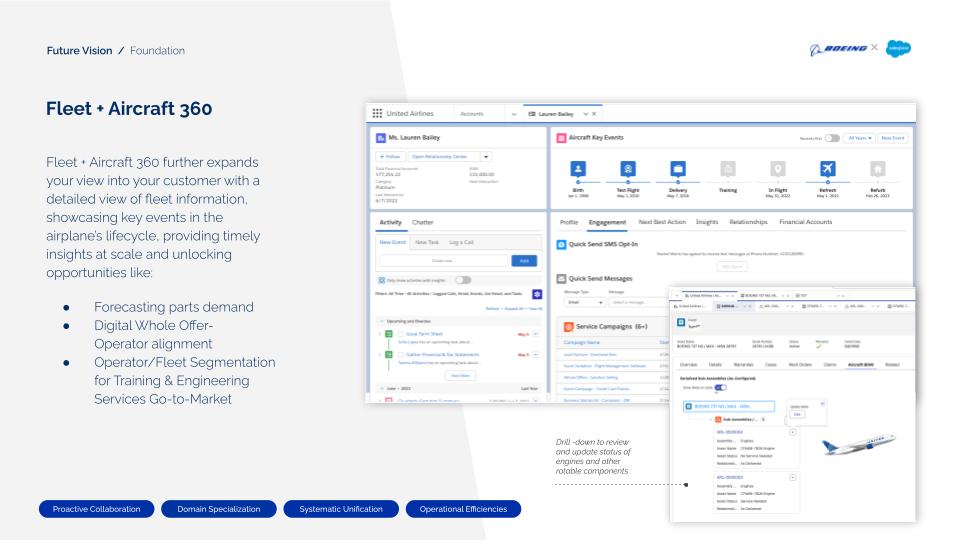
The future-state vision rests on a unified Customer 360 + Fleet & Aircraft 360 — a single, real-time view of the operator and their fleet that every team in BGS works from. On top of that foundation, we defined four excellence layers, each tied to specific moments that matter for the people doing the work.

Foundation · Customer 360 + Fleet & Aircraft 360

A connected landscape giving every team a 360° view of the operator, the fleet, and the events in each airplane's lifecycle — the basis for everything else.

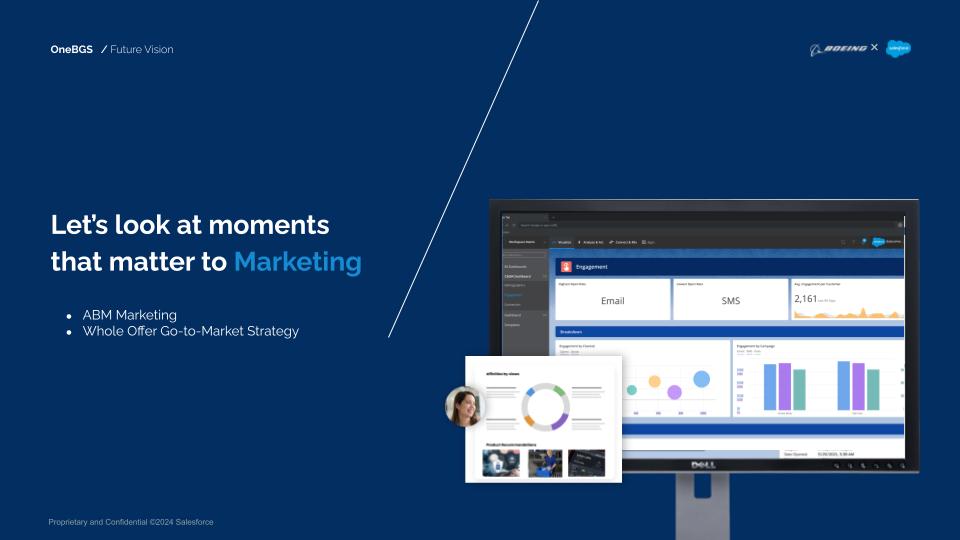
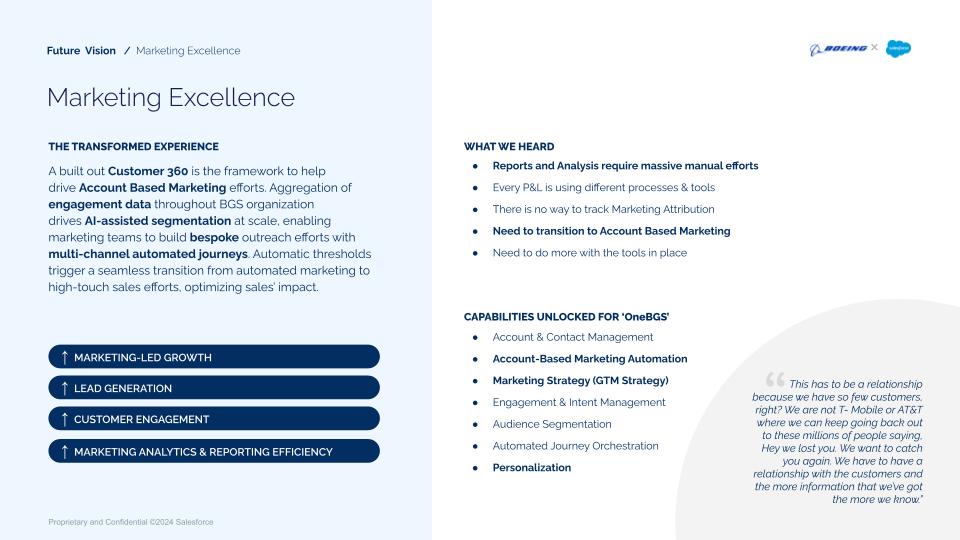
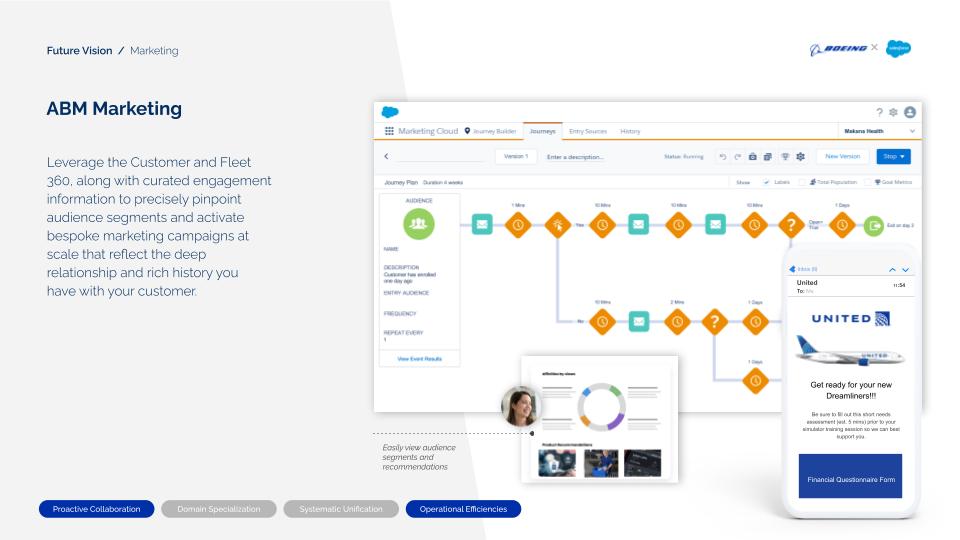
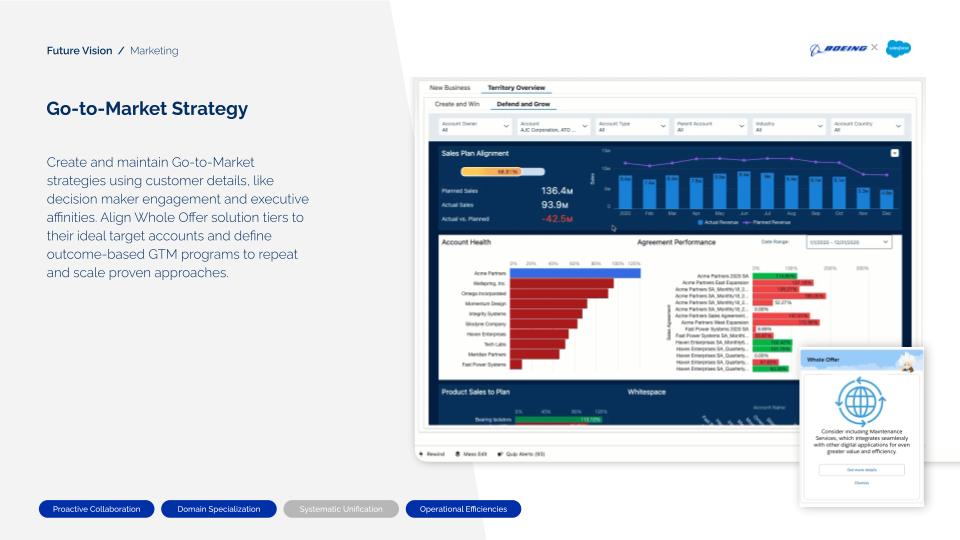
Marketing Excellence

Account-Based Marketing automation, GTM strategy, and journey orchestration grounded in the same customer record sales and service use.

Sales Excellence

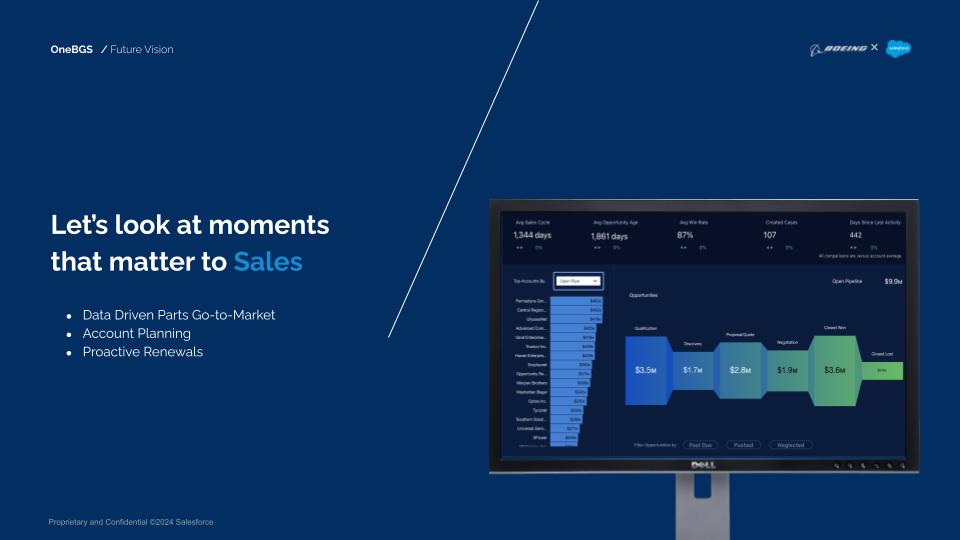
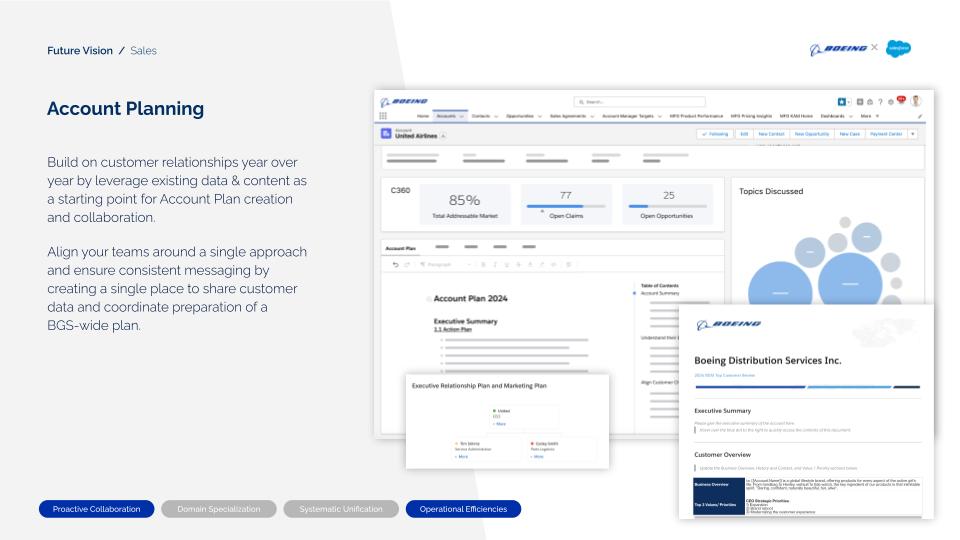
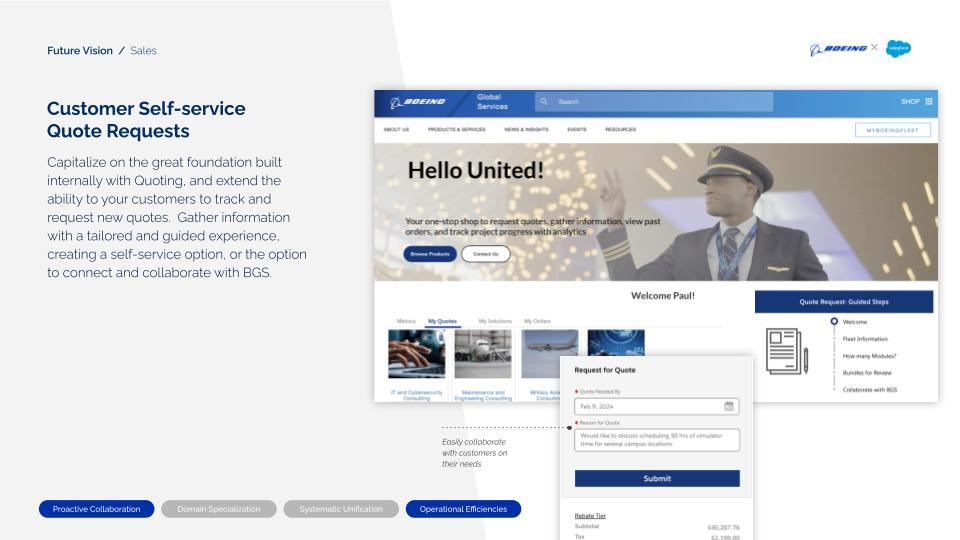
Data-driven white-space analysis, account planning, customer-facing quote requests, and proactive renewal management.

Service & Support Excellence

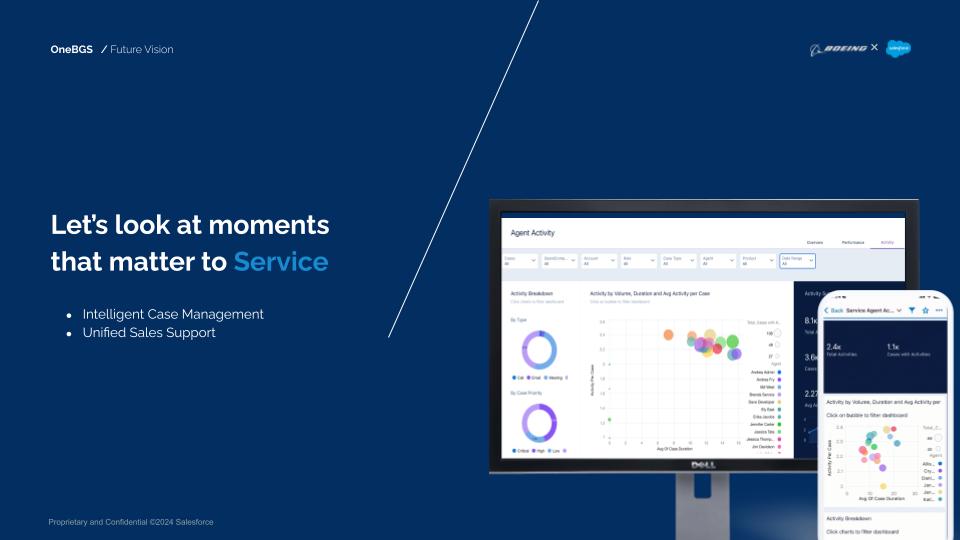
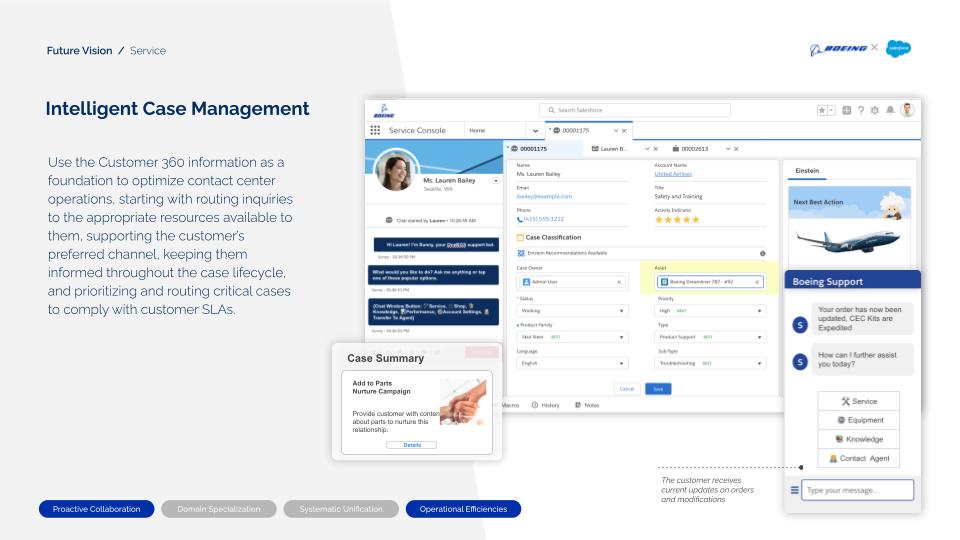
Intelligent case management, unified order servicing across P&Ls, and omni-channel customer self-service.

Execution Excellence

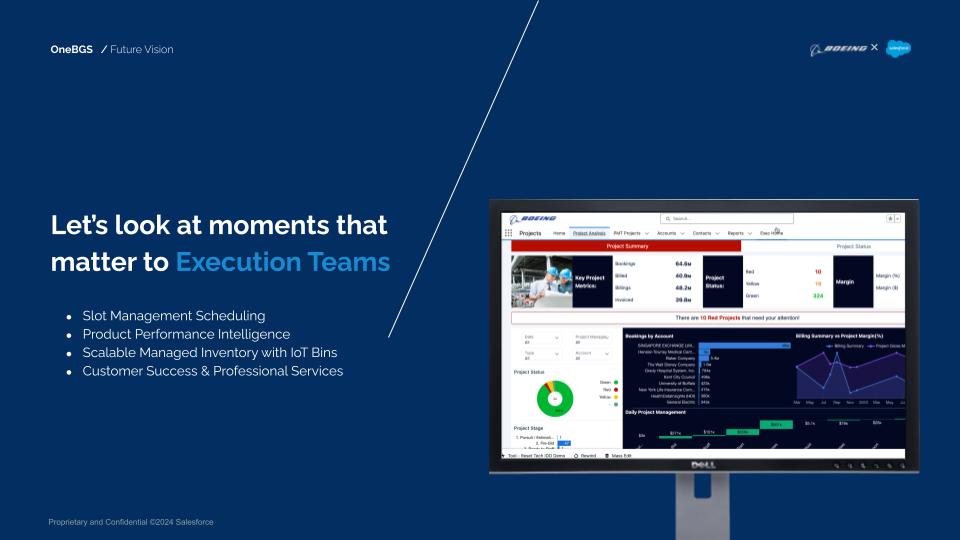
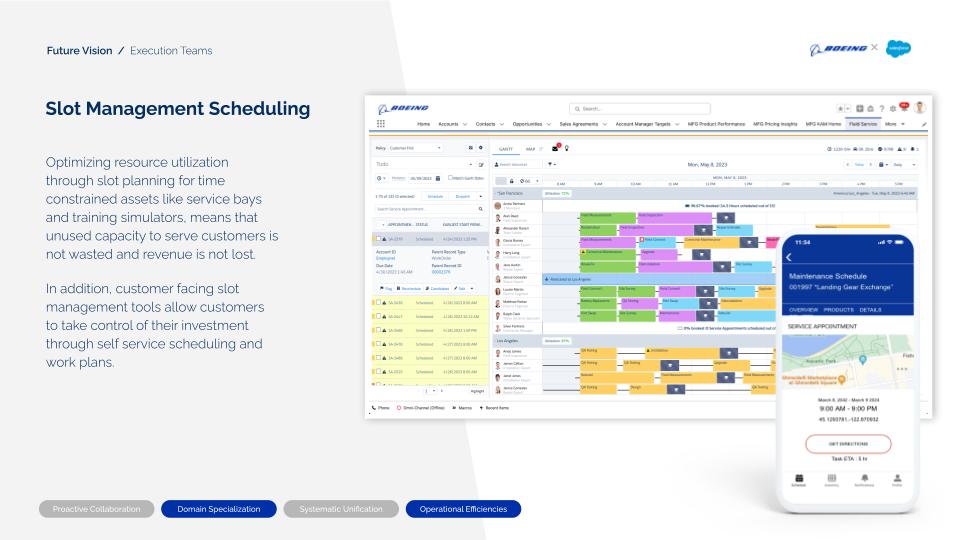
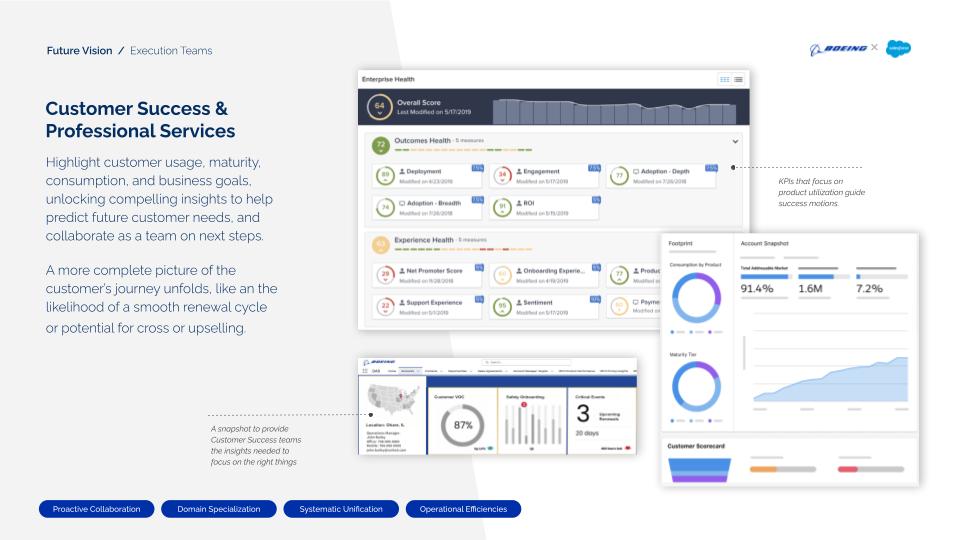
Slot management scheduling, product performance intelligence, scalable Managed Inventory with IoT bins, and Customer Success tooling.

The vision statement

Salesforce as the catalyst to accelerate customer-centered transformation — uniquely positioning BGS as the purveyor of choice for commercial aviation aftermarket parts and services.

03 / Value & Roadmap

Translating the vision into a defensible business case and a phased plan.

Business value

The Salesforce Business Value team partnered with us to translate the future vision into a quantified hypothesis grounded in Salesforce benchmarks and BGS-specific operating data. We modeled three scenarios:

$206–302M
Annual revenue lift (conservative → optimistic case)
250–350%
Typical ROI on the platform investment
12–16 mo
Typical payback period
Where the value lands
  1. Parts cross-sell / up-sell — white-space analysis on commercial operators drives ~$85M revenue lift.
  2. Software sales & renewals — Customer + Fleet 360 insights drive ~$72M incremental software revenue.
  3. Customer retention / CSAT — personalized engagement and self-service recoup ~$30M annually.
  4. Slot management utilization — efficient training scheduling adds ~$18M.
  5. Employee efficiency, call deflection, and AHT reduction — ~$6M in operational cost savings.
Figure 08
Strategic roadmap — 4 phases across PI 9 → PI 16, with cumulative margin benefit modeled by phase.
04 / Outcome

From a four-month engagement to a three-year platform roadmap.

Impact

The future vision was endorsed by Boeing leadership and translated into a three-year platform roadmap: 22 epics, 213 features, four P&Ls, with H1 2024 focused on building the Customer 360 + Fleet & Aircraft 360 foundation.

The work gave BGS executives a shared vocabulary — People · Process · Technology · Data, aligned around the customer — for evaluating every subsequent investment decision against the OneBGS ambition.

Next case study
Abbott