Case study · 05 of 05

One console for every service moment, for American Family's agents and Care Center reps.

Client
American Family Insurance
Role
Senior Experience Architect
Year
2021
Disciplines
Service Design · Research · Salesforce

American Family sought to create an engaging, cohesive customer and agent experience across the entire customer lifecycle, sales and service, on Salesforce. The goal was to drive agent adoption, reduce manual processes, and bring value to agents, customers, and the business.

Over twelve weeks, I led a collaborative team from Salesforce Design, Engineering and Sales to work closely on the service experience, moving from research through a co-creation workshop to a validated future-state prototype for Care Center reps and agencies.

Process

A design-led, human-centered approach to redesigning process and technology. We balanced business goals, human insights, and technology capability, starting from the people doing the work so the platform would drive adoption and ROI.

Stakeholders defined the target outcomes at the service kickoff. The three top-voted were personalized service communications ("a feeling like they know me"), an intuitive self-service system with learning embedded, and first contact resolution.
19
Research participants: 7 stakeholders and 12 end users
11
Validation sessions with end users on the future-state prototype
12 wks
Plan, discovery, design and refine, design framework
Who we talked to

Agency managers, agency staff, Care Center reps, and storefront staff, alongside stakeholders from Care Center Operations, Training and Performance, and S&SO.

01 / Research

Too many systems standing between people and the customer.

Personas

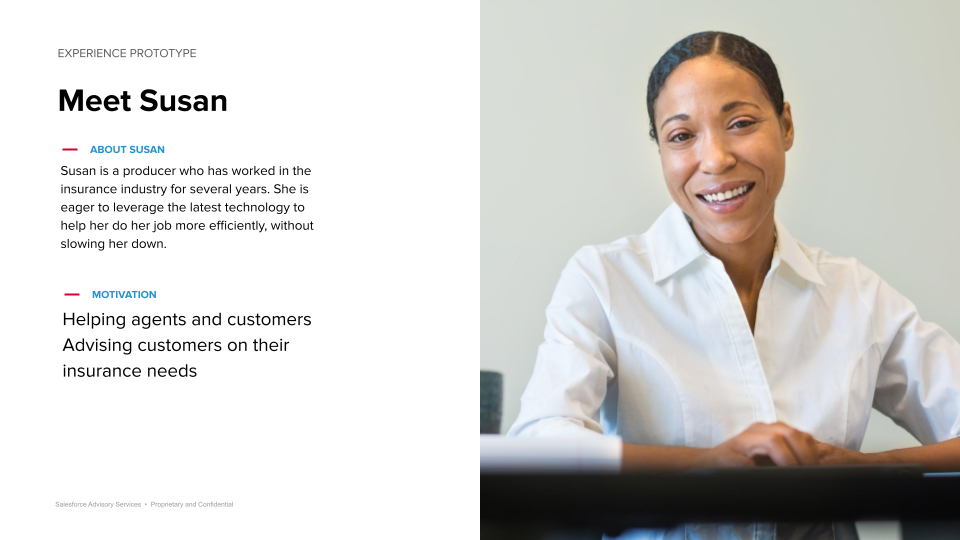
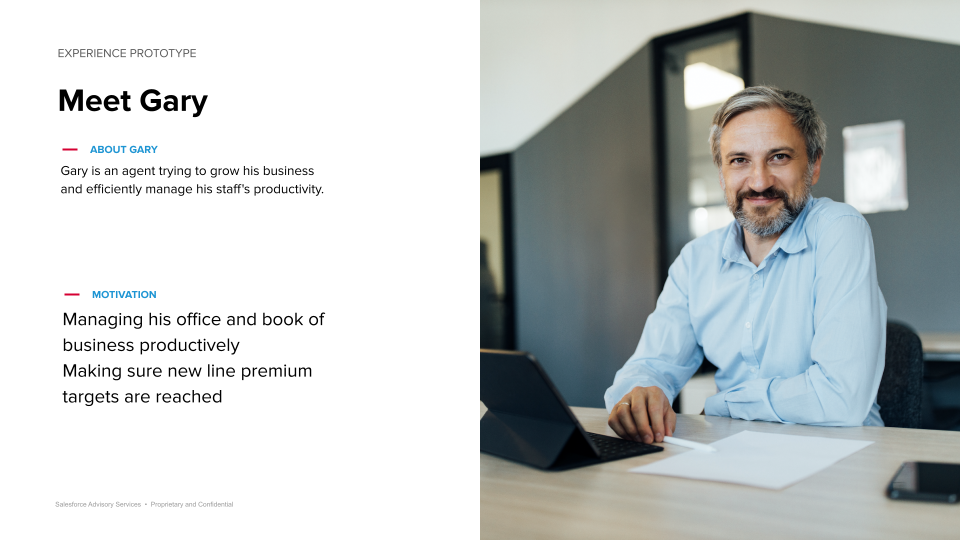
Research produced three personas. Gary, an agency manager, needs real-time insight into his book of business but spends his time setting up manual processes. Susan, a producer, needs reliable data, connected systems, and proper training to help her customers. James, a Care Center case solver, has no relationship with the customers who contact him and must be a general expert on every policy and billing system in every state AmFam serves.

"I can't be engaged in sales because I spend too much time focusing on getting manual processes setup for my team."

Gary, Agency Manager persona

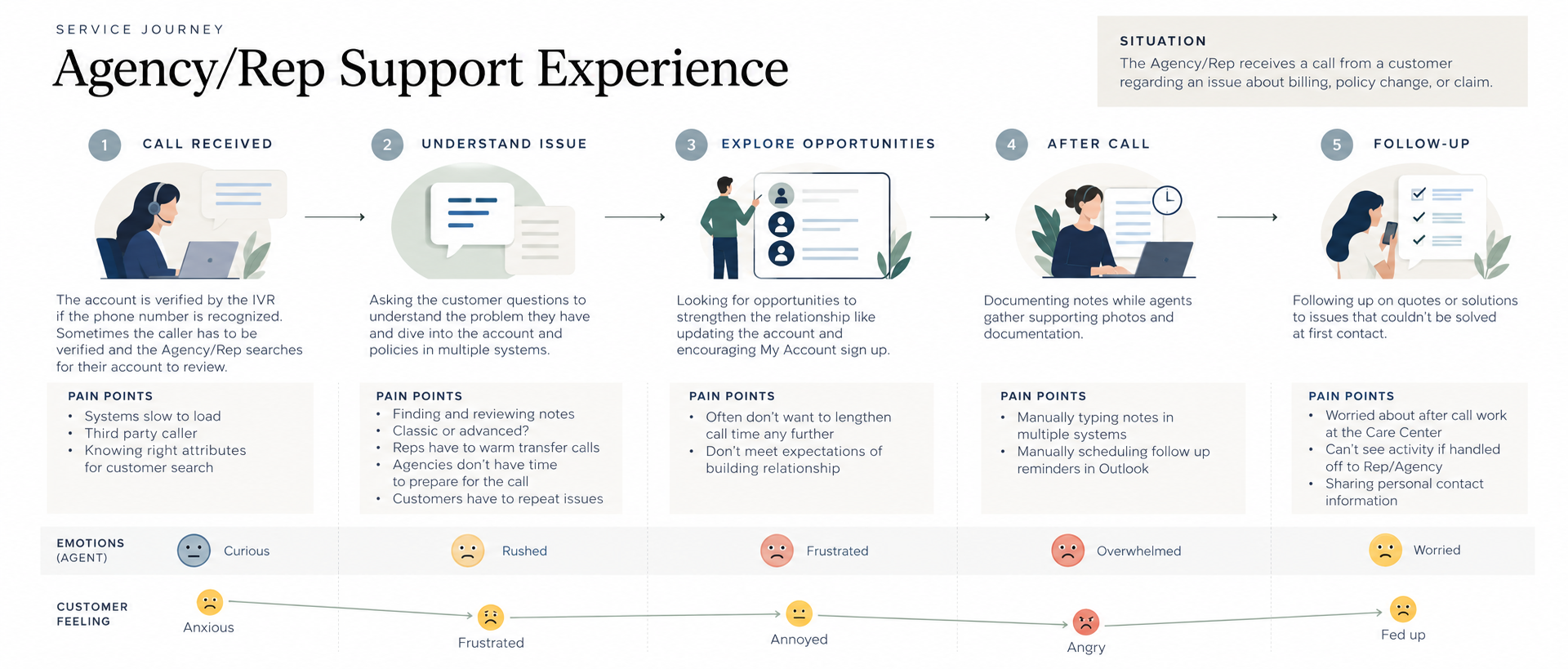
Agency/Rep Support Experience service journey. Situation: the Agency/Rep receives a call from a customer about billing, a policy change, or a claim. Five stages: Call Received, Understand Issue, Explore Opportunities, After Call, Follow-up, each with pain points such as slow systems, finding notes, warm transfers, manually typing notes in multiple systems, and scheduling follow-ups in Outlook. Agent emotions move from curious to rushed, frustrated, overwhelmed, and worried; customer feeling moves from anxious to frustrated, annoyed, angry, and fed up.Click to view full detail
Figure 01Current-state service journey, Agency and Rep, from call received to follow-up.
Eight themes

Most of the service goals and challenges we heard group into eight themes. Each one became an opportunity, and each opportunity is visible in the future-state prototype.

01

A holistic picture of a customer need is required for empathetic service, but requires time and system expertise to collect.

"Premium changes take the most steps to investigate: confirm, why, was it a midterm change? So many variables with premium, that's our biggest obstacle."Care Center Rep
02

Reps want to do what's best to resolve customer issues, but do not always have the tools or incentive to do so.

"My manager is very supportive of after work selling activities, some aren't. Other reps would put clients on hold to do the selling activities."Care Center Rep
03

Text is increasingly used, but current systems require multiple steps and create possible compliance issues.

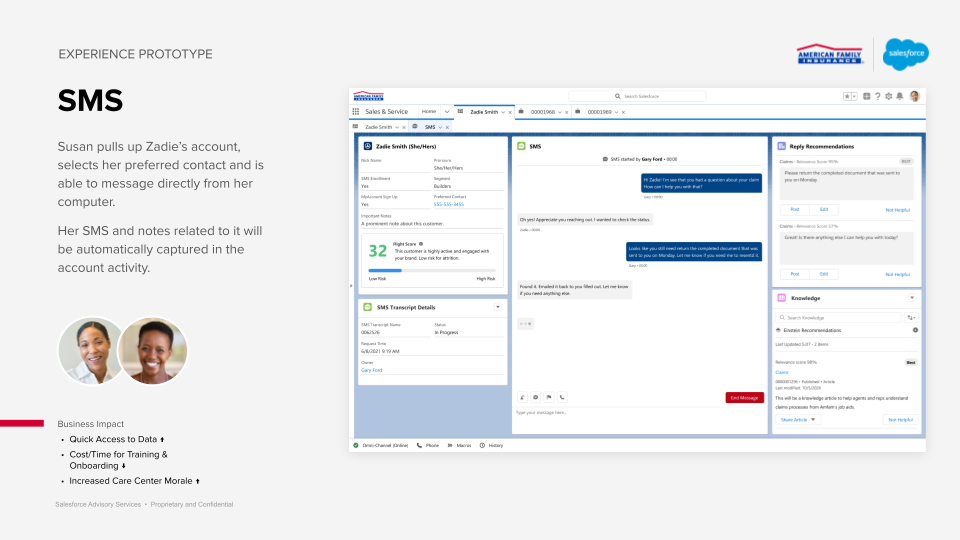
"Wish we had a way to text from our computer rather than use my personal cell phone."Care Center Rep
04

Reps and agents are continuously training, but system and policy complexity demand new ways to learn.

"It takes an average of 72 weeks to be fully trained."Research finding
05

Cross sell decisions require comprehensive information and time, making completing these sales difficult.

"In three systems to quote umbrella and also have to do accurate math."Agent
06

Service requests are resolved by individuals and teams, but current systems lack support for unique work structures.

"I have a team email inbox to manage for service. My staff has their list of tasks to do, but they can pick up the next one if someone's unavailable."Agent
07

Agents hold the customer relationship but, in times of need, lack visibility into full account activity.

"I can only see that the claim has been opened or if a check is issued. I have to refer customers to the adjuster to answer their questions."Agent
08

Difficulty in discovering account history leads to distrust and confusion between agents and reps.

"Care center reps are always new and training. I can offer better quality service from my agency and I prefer to handle it here."Agent
02 / Workshop

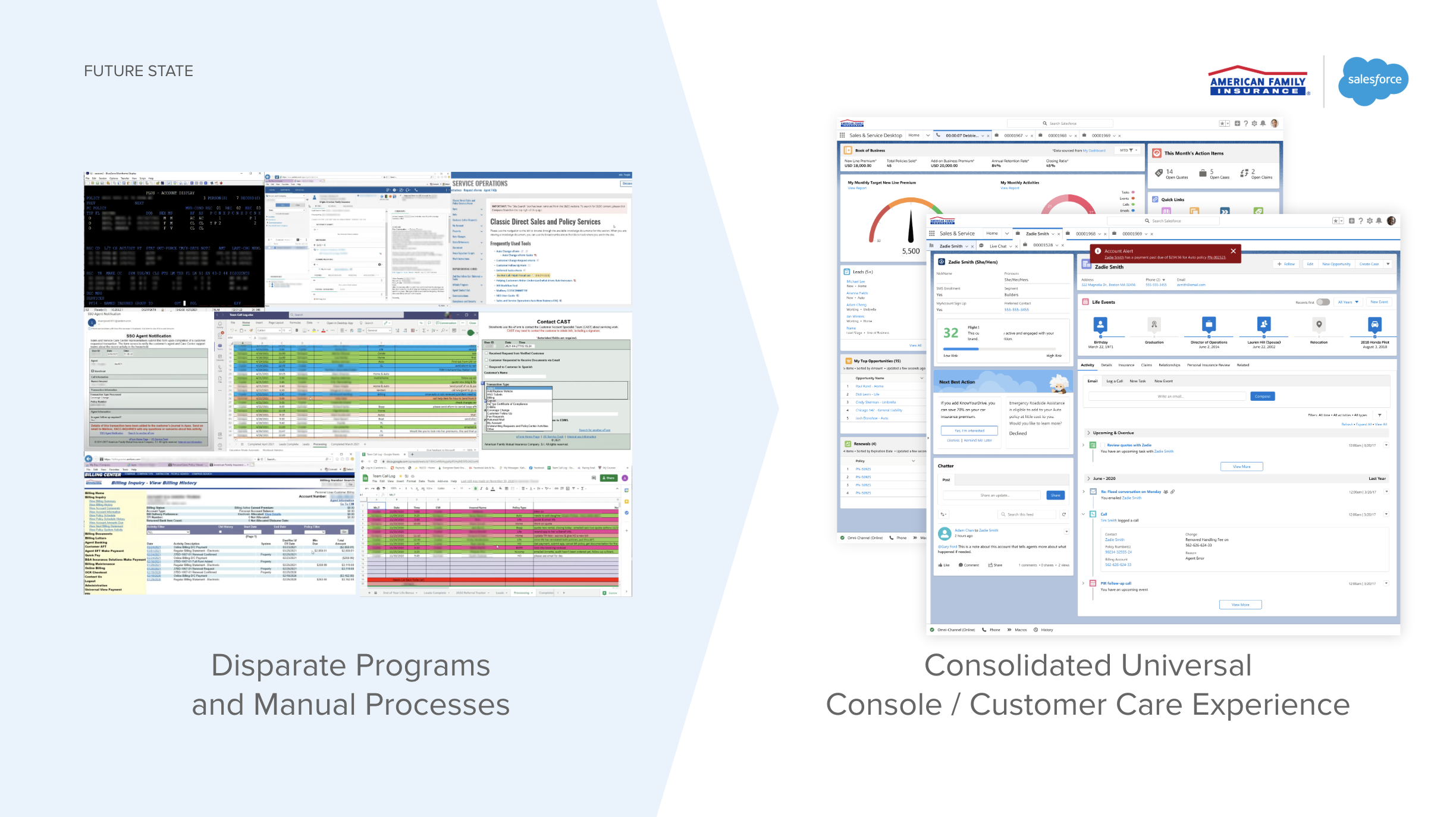
From disparate programs to a consolidated console.

Co-creation

A co-creation workshop turned the research into need statements and storyboards. Three priorities emerged:

  • Create and hand off opportunities to those best suited to serve the customer.
  • Automate account notes and streamline communication about account activity.
  • Identify key customer information and time-sensitive details at first glance.
03 / Future State

One customer, three roles, one connected story.

Prototype

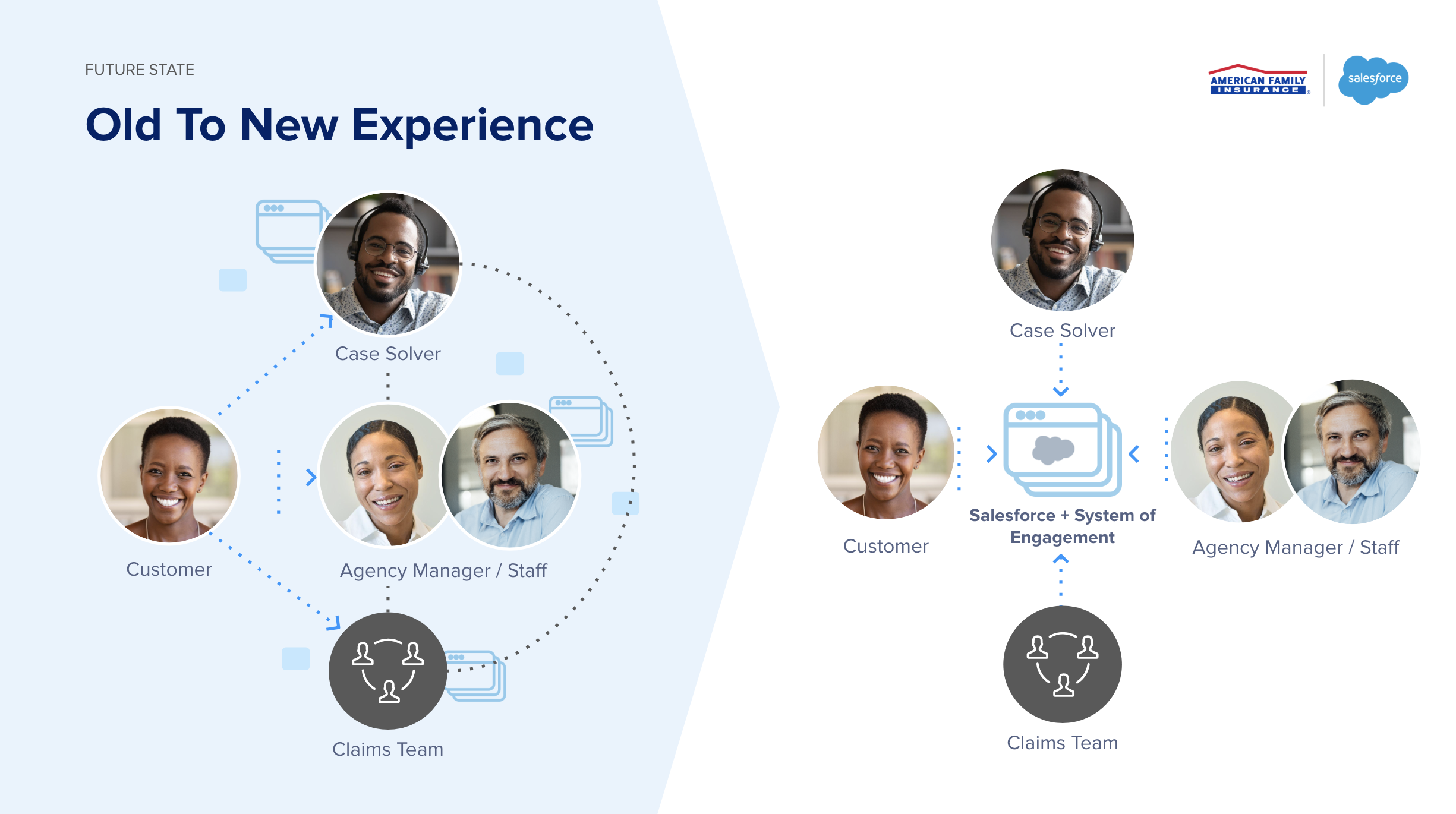
We built a Figma experience prototype that follows a single customer, Zadie Smith, through the hands of three people. Each step was tied to its expected business impact and validated with end users.

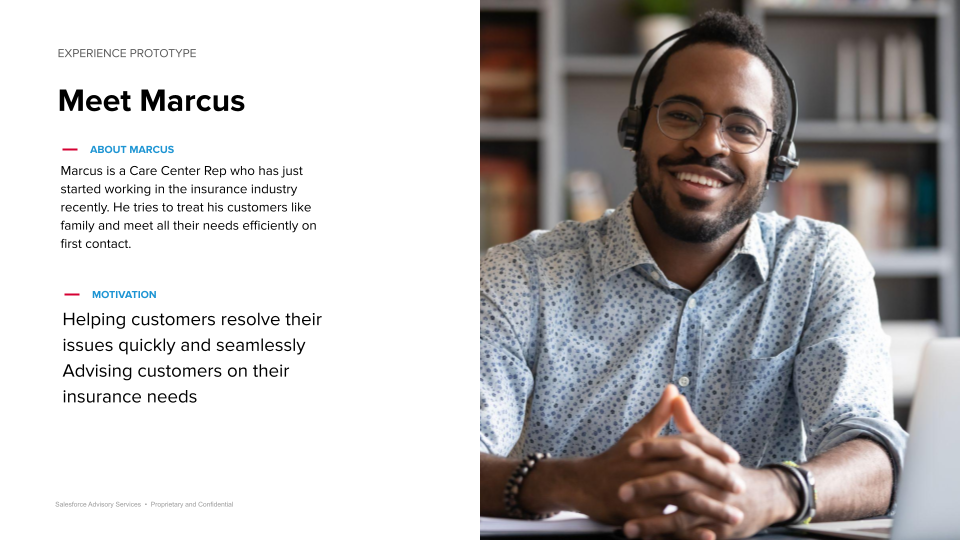
Marcus, Care Center Rep

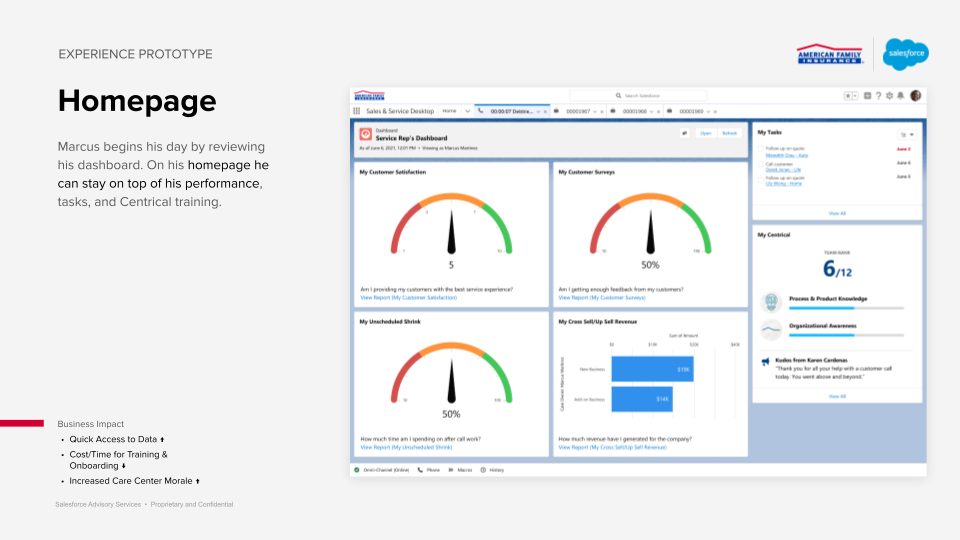
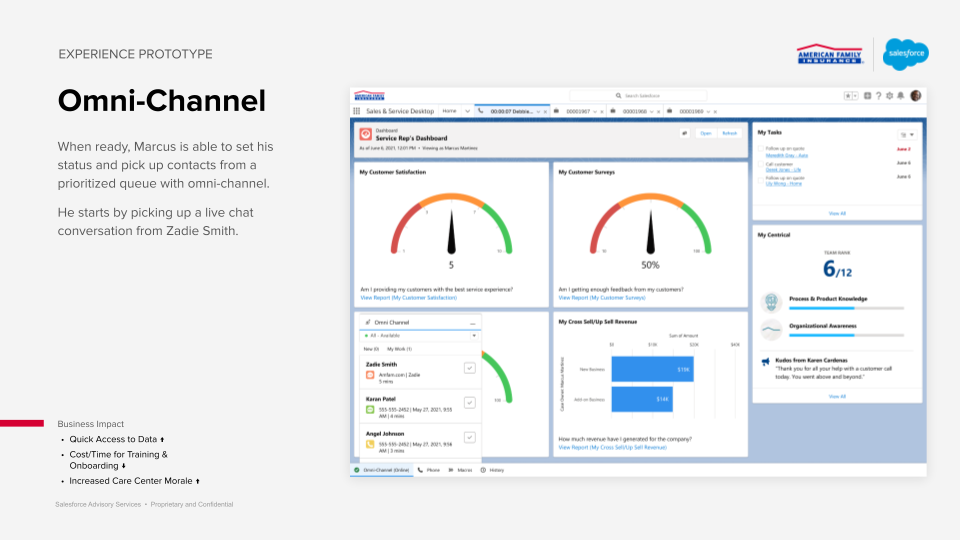
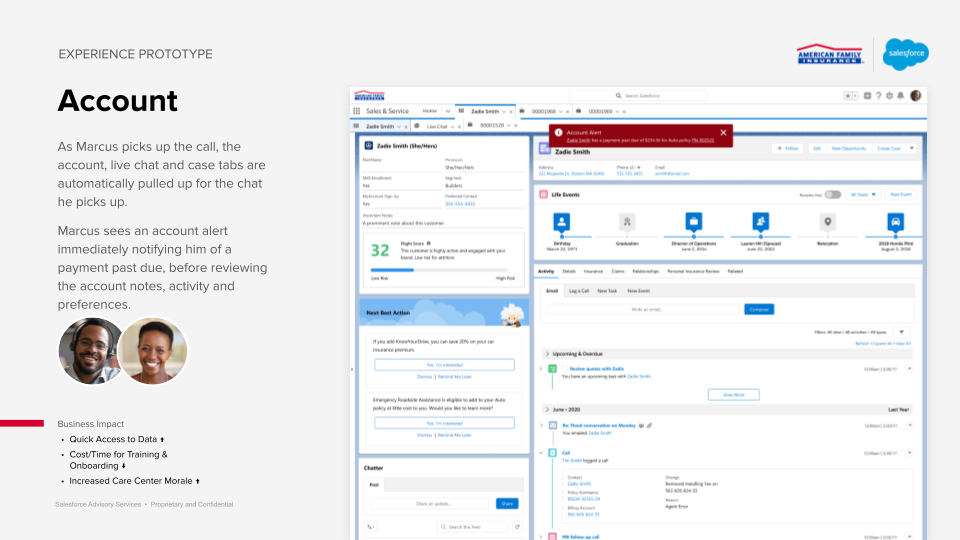
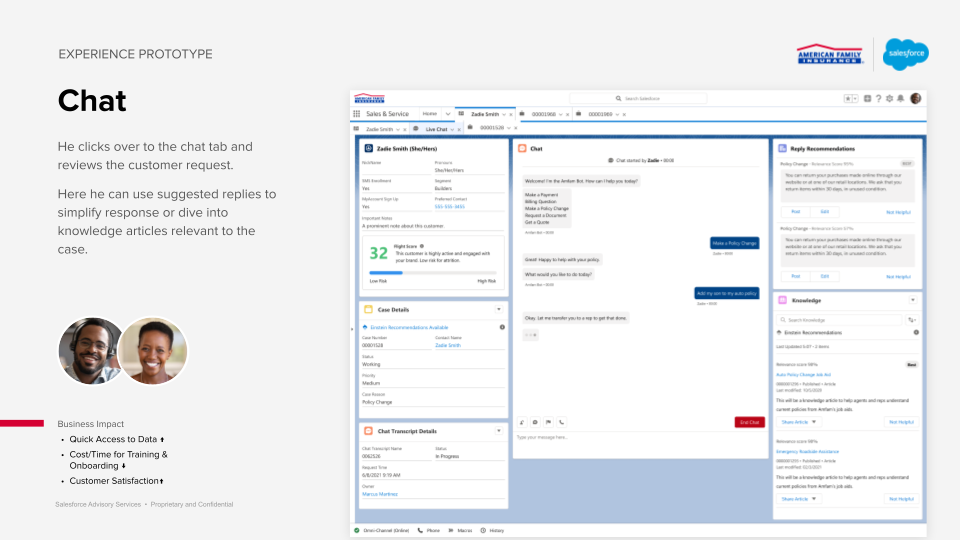
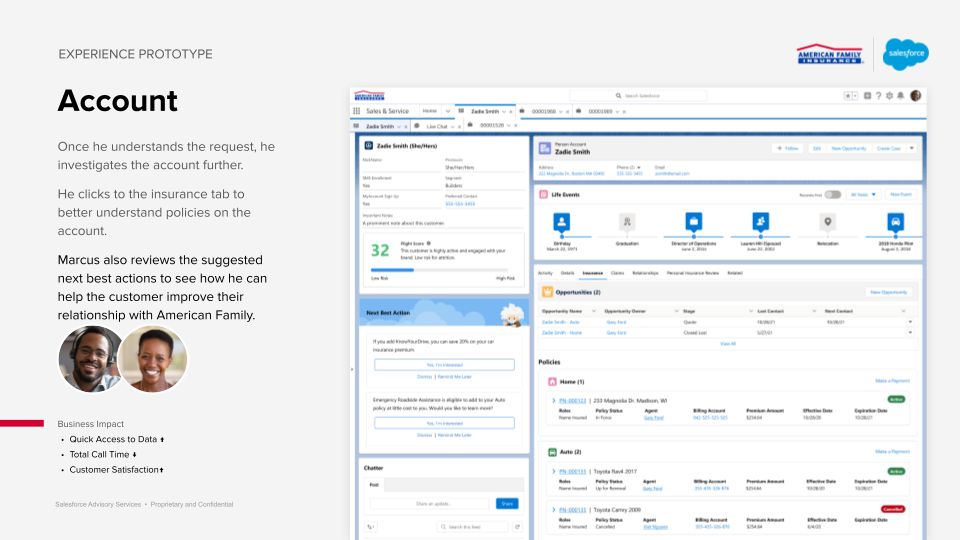
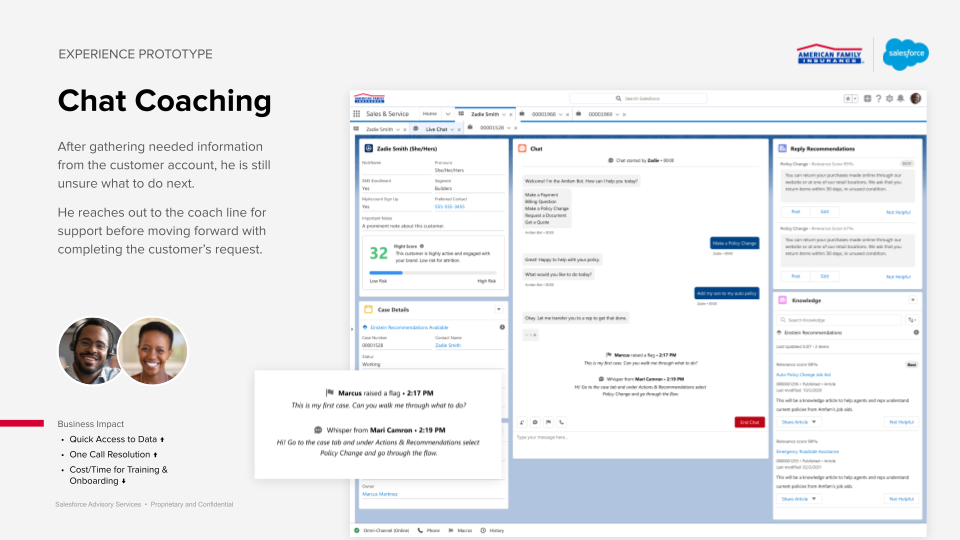
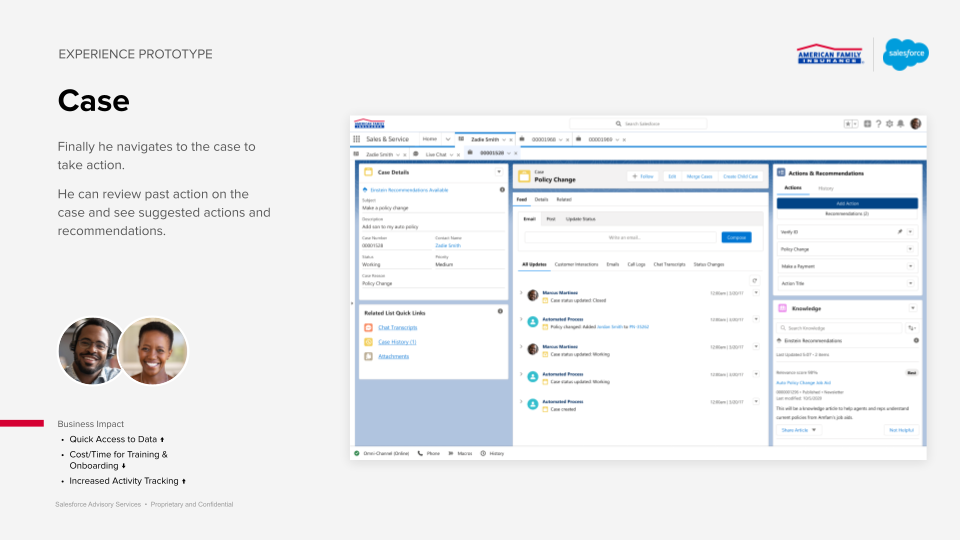
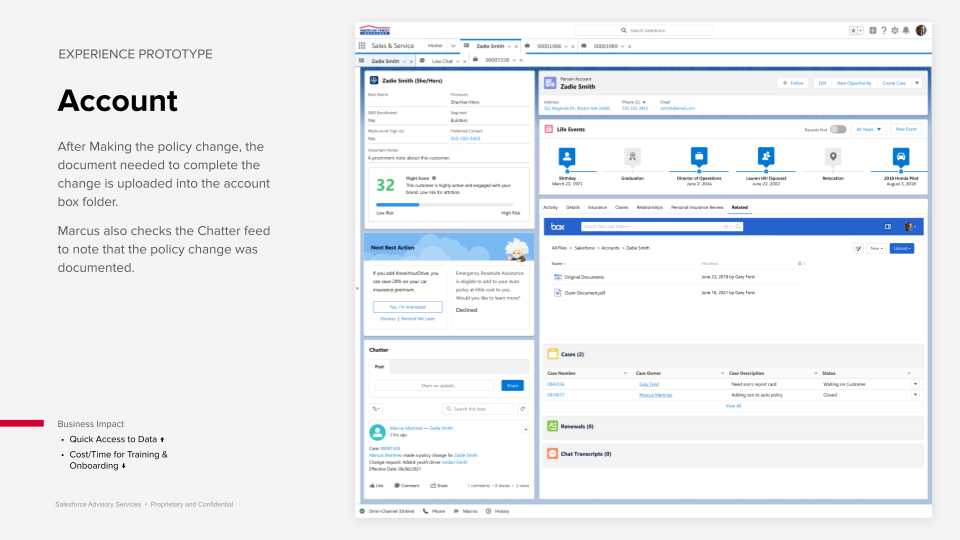
New to insurance. He picks up Zadie's chat from a prioritized omni-channel queue. The account, chat, and case open together, with an alert for a past-due payment. Suggested replies, knowledge articles, next best actions, chat coaching, and guided action flows help him make a policy change on first contact, captured in the account Chatter feed.

Susan, Producer

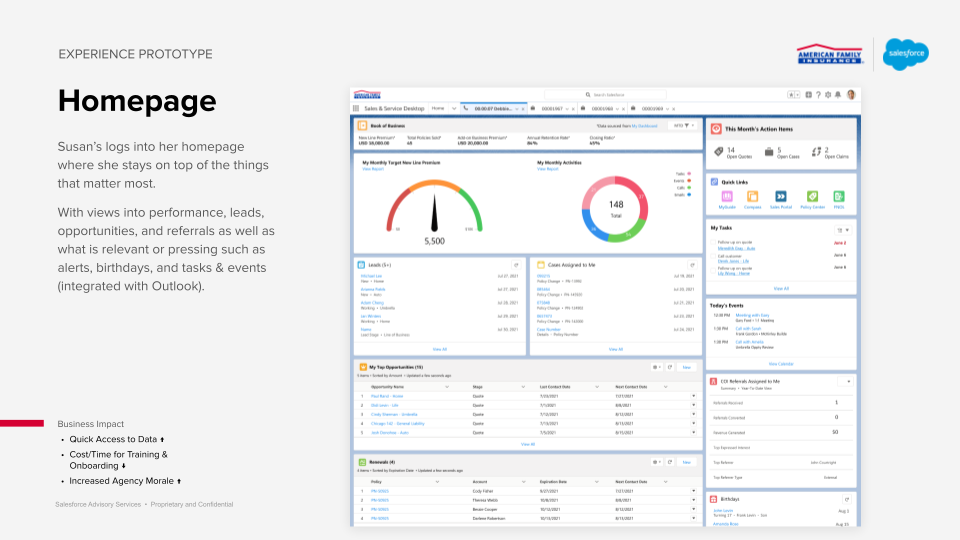
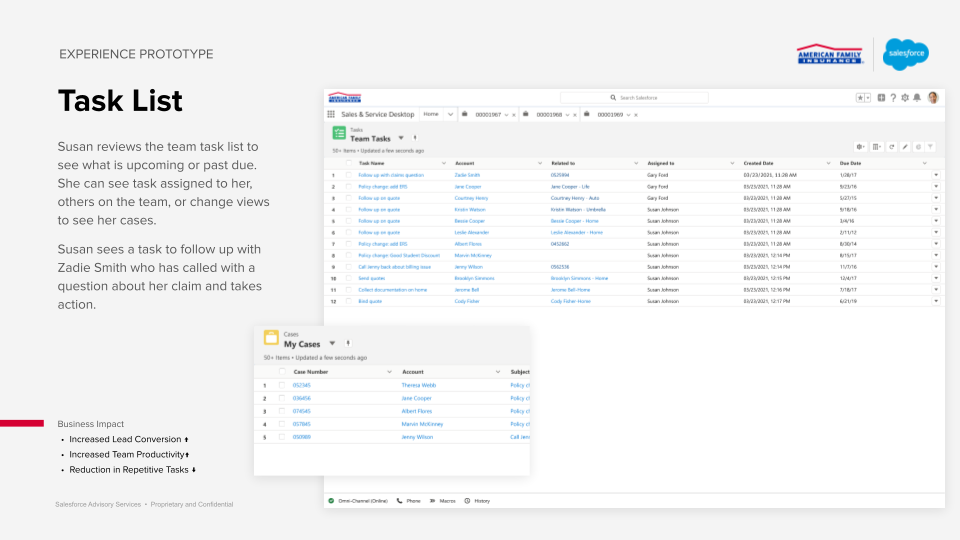
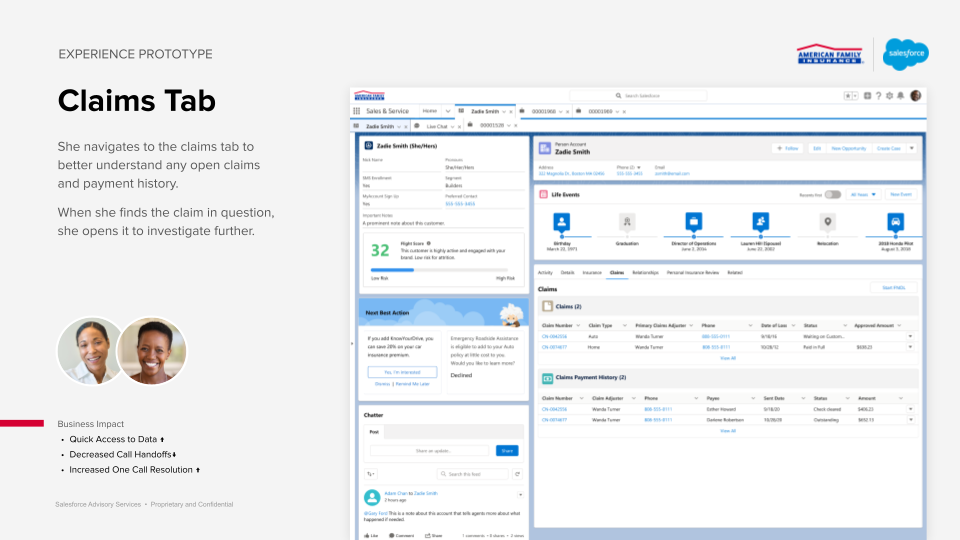
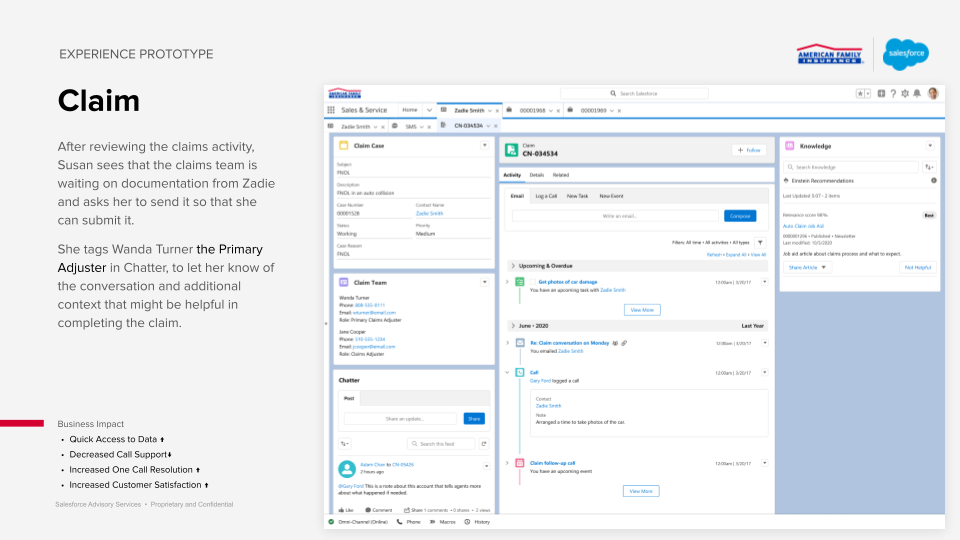
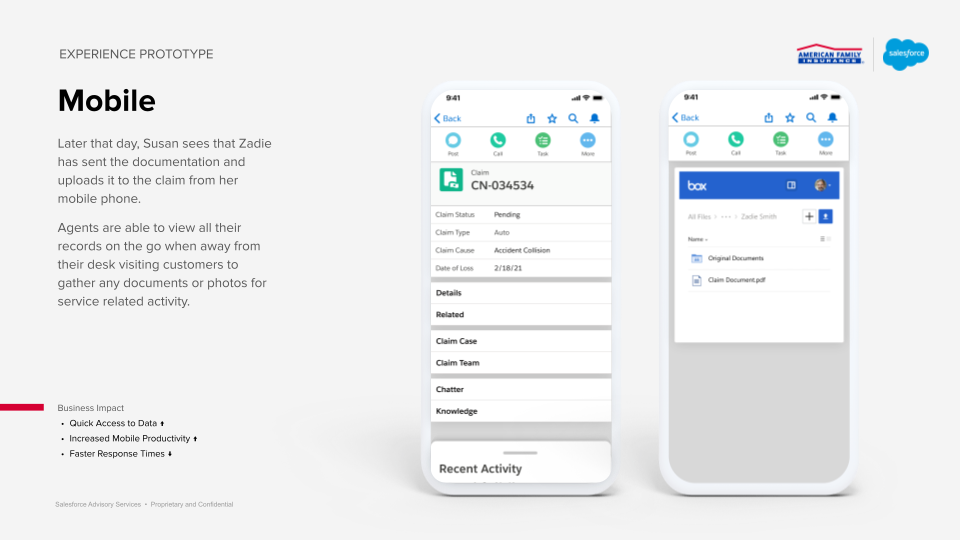
From the team task list, she follows up on Zadie's claim question by SMS from her desktop, logged automatically to account activity. In the claims tab she sees the team is waiting on documents, tags the adjuster in Chatter, and later uploads Zadie's documents from her phone.

Agency

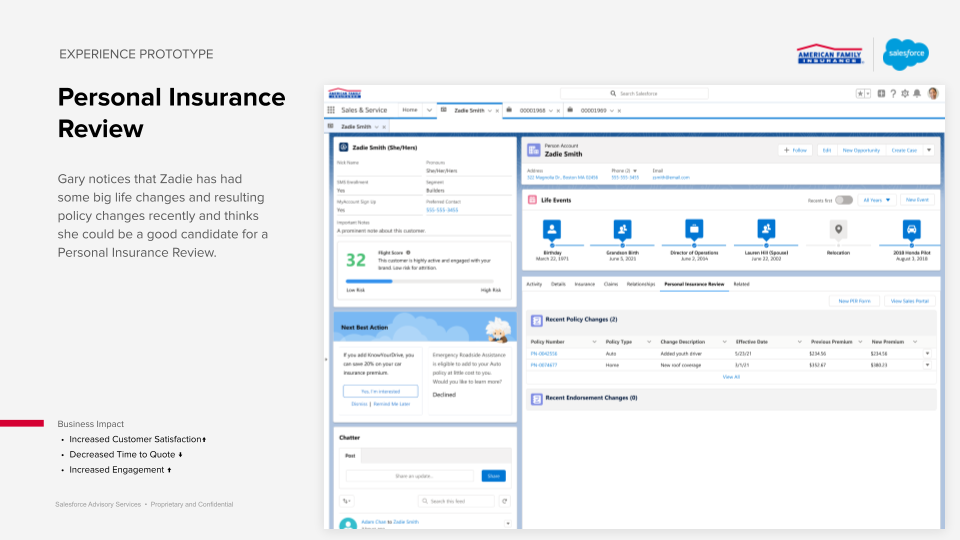
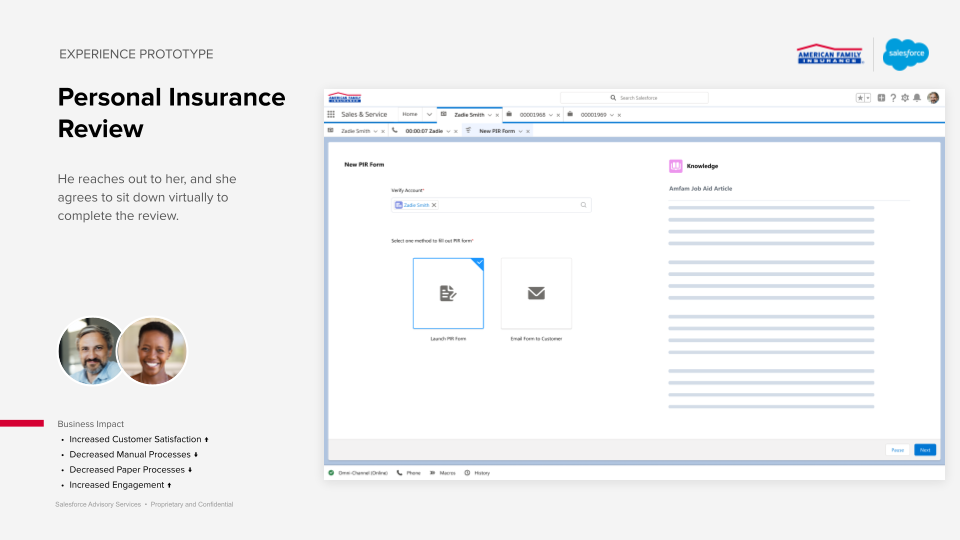
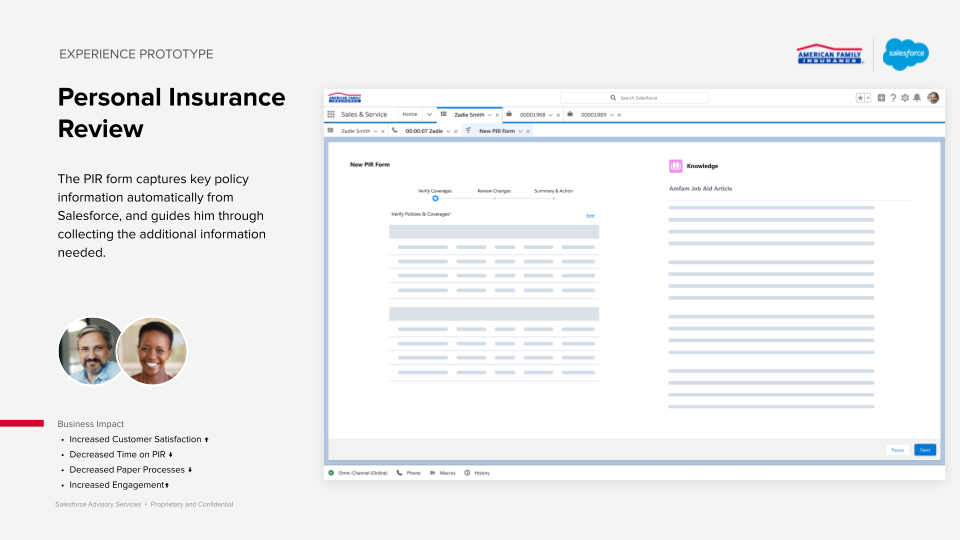
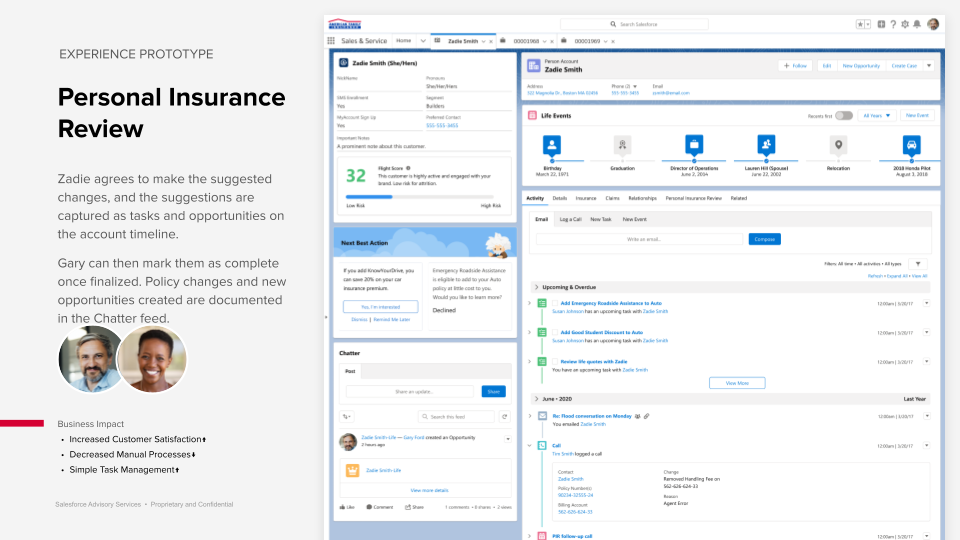
Gary, the agent, notices Zadie's recent life changes and invites her to a virtual Personal Insurance Review. The form pre-fills policy information from Salesforce, guides him through what's missing, and recommends coverage changes and discounts. Accepted suggestions become tasks and opportunities on the account timeline.

04 / Framework

Principles and a roadmap the team could build from.

Principles

We narrowed the insights and Lightning Design System best practices into six guiding experience principles: Simplify, Relevant, Automate, Anticipate, Unify, and Build Trust.

Key epics

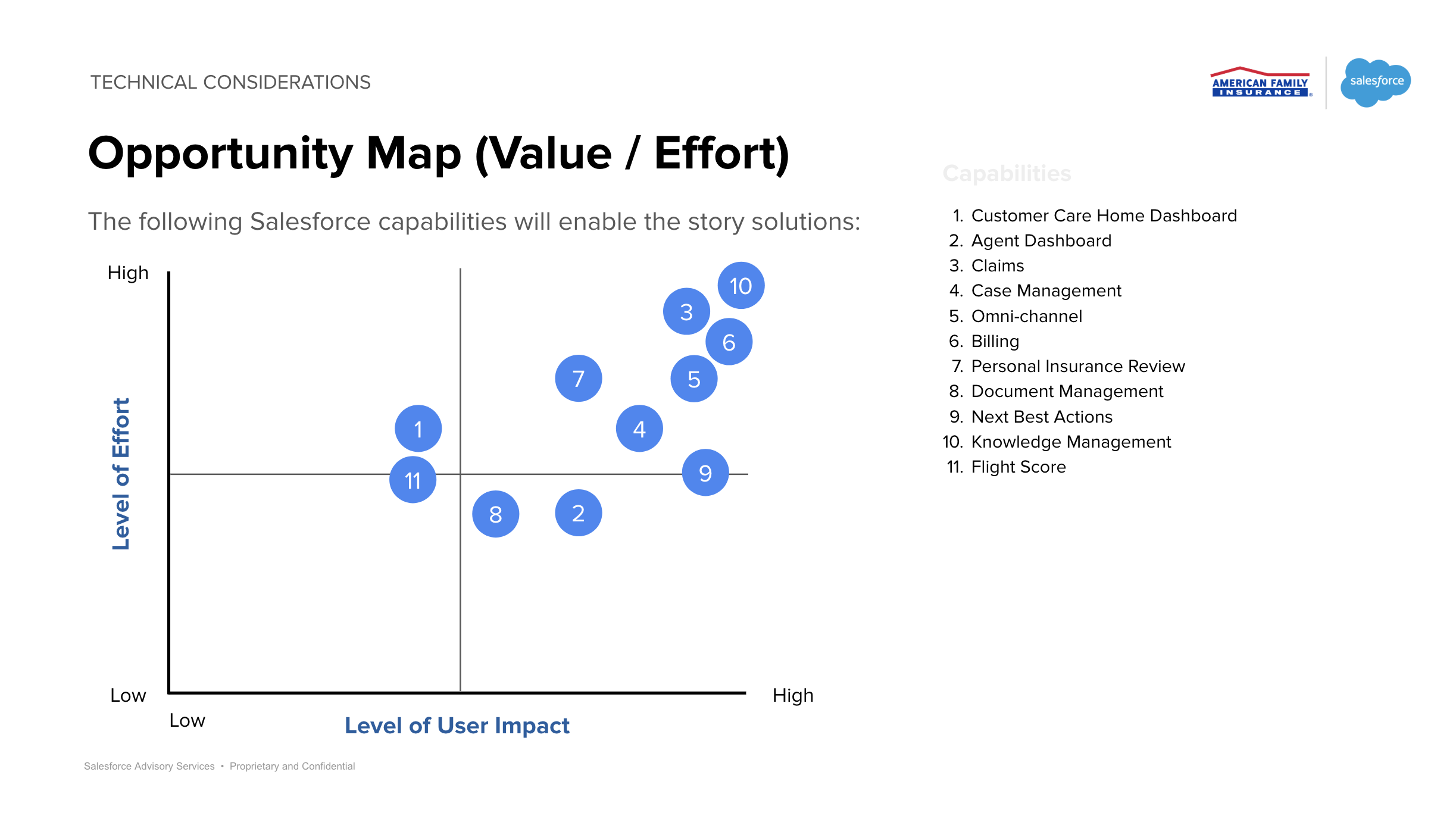
Eleven capabilities enable the stories: Customer Care Home Dashboard, Agent Dashboard, Claims, Case Management, Omni-channel, Billing, Personal Insurance Review, Document Management, Next Best Actions, Knowledge Management, and Flight Score. Each was plotted by user impact and level of effort to sequence delivery.

Opportunity Map (Value / Effort). Eleven Salesforce capabilities plotted by level of user impact and level of effort: Customer Care Home Dashboard, Agent Dashboard, Claims, Case Management, Omni-channel, Billing, Personal Insurance Review, Document Management, Next Best Actions, Knowledge Management, and Flight Score. Most sit in the high-impact half; Claims, Billing, and Knowledge Management are highest effort, while Agent Dashboard and Document Management are high impact with lower effort.Click to view full detail
Figure 05Opportunity map, key capabilities by user impact and level of effort.
05 / Outcome

A vision American Family could build.

Delivered

We delivered three things to carry the experience into development:

  • A detailed future-state vision: the validated prototype, told through Marcus, Susan, and Gary.
  • Epic prioritization: the eleven capabilities, ranked by user impact and level of effort.
  • A technical roadmap: how the epics would be sequenced to build the experience the following year.
Next case study
Autodesk→